
Every rate you publish is a judgment about what the market will bear. Your own booking pace tells you how that judgment is holding up, but it says little about the market around you: whether rates across your destination are climbing, or whether rooms are quietly running out.
Vietnam Travel Demand Monitor (VTDM), Outbox Intelligence’s travel demand monitoring and intelligence platform, gives you that outside view. Its Demand Pressure Index (DPI) and dashboard tab follow hotel pricing and availability signals across Vietnamese destinations, so you can see how the accommodation market is shifting from day to day.
Here is what the index tells you, how to explore it, and how revenue and commercial teams can use it to review pricing, time promotions and find where the market is tightening or loosening.
What Is the Demand Pressure Index (DPI)?
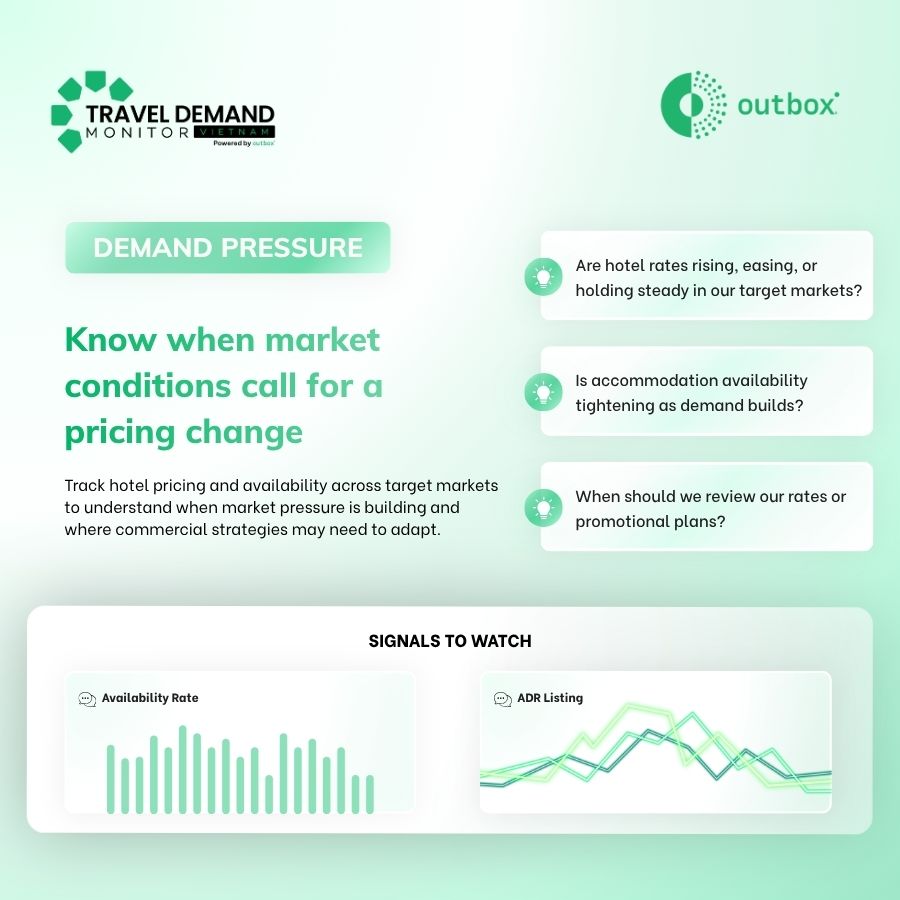
The Demand Pressure Index (DPI) tracks changes in hotel market conditions through two key indicators: average daily rates (ADR) and accommodation availability. By bringing these indicators together, it provides a consolidated view of how pricing and available room supply are shifting across destinations.
When room rates increase as availability declines, it may indicate growing pressure on the accommodation market. Conversely, declining rates and increasing availability may point to easing market conditions. Updated daily, the DPI helps businesses keep track of these shifts and understand how hotel market conditions vary across Vietnamese destinations.
The Demand Pressure tab allows users to examine the factors behind the index, with breakdowns by destination, destination type and hotel segment. VTDM covers both domestic and outbound travel markets among Vietnamese travelers, with domestic coverage spanning all 34 provinces and centrally governed cities in Vietnam.
Worth remembering: Demand Pressure reflects changes in listed room rates and availability, not confirmed bookings or actual occupancy. These indicators can also be shaped by accommodation supply, pricing strategies and seasonal patterns. A rise in market pressure should therefore be considered alongside other market signals when assessing destination performance and business opportunities.
Questions Demand Pressure Helps You Answer
- How are hotel rates changing across target destinations?
- Where is accommodation availability tightening or becoming less constrained?
- What do changing pricing and availability patterns suggest about market conditions?
- Which lodging segments are feeling the most pressure?
What You Can See in the Demand Pressure Dashboard
How tight the accommodation market is
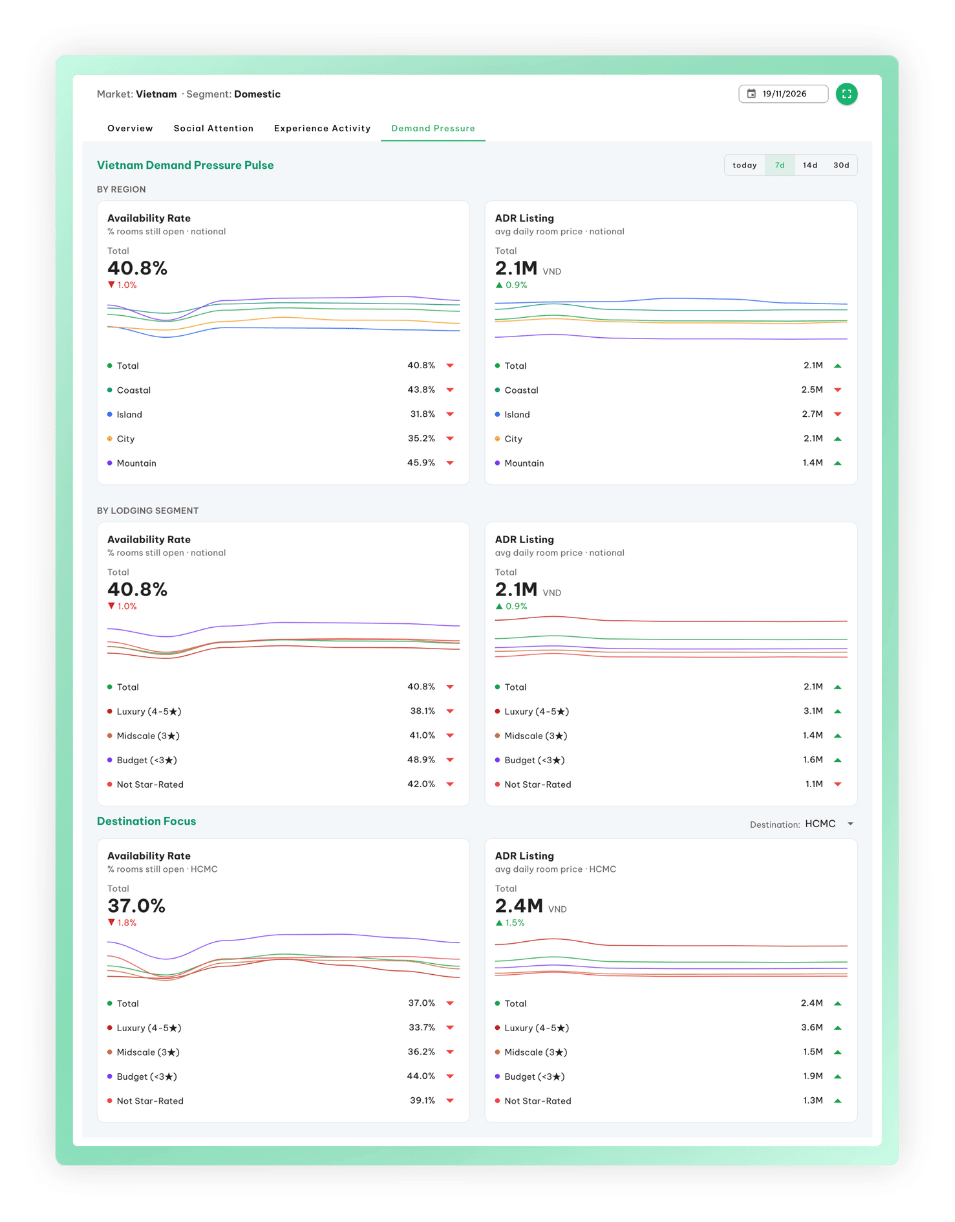
Availability Rate measures the proportion of listed rooms that remain available in a destination. Tracking changes in this rate helps users assess how much accommodation supply is available in the market. A declining rate indicates that fewer listed rooms remain available, potentially pointing to tighter market conditions.
How are room rates moving?
ADR Listing tracks average daily room rates across destinations, providing visibility into changes in accommodation pricing. Users can monitor whether rates are increasing, easing or remaining stable, and compare pricing movements across markets to understand how accommodation costs are evolving.
Where is market pressure concentrated?
Explore differences in market conditions across destination types, from coastal to mountain destinations, and accommodation segments, from luxury to budget. These breakdowns help identify which destination categories and hotel segments are experiencing tighter availability or notable pricing movements, revealing where market pressure is most pronounced.
Are these short-term fluctuations or sustained market shifts?
Compare daily data with 7-day, 14-day and 30-day views to put individual market movements into a broader timeframe. This allows users to distinguish short-lived changes from more consistent shifts in room availability and pricing, providing a clearer basis for interpreting market conditions.
How does your destination compare with the national market?
Destination Focus brings the analysis down to an individual destination, allowing users to examine its availability and pricing movements alongside the national market. Further breakdowns by accommodation segment reveal how different parts of the local hotel market are performing relative to the broader picture.
A Practical Example: Assessing Your Destination's Market Position
Imagine a revenue manager at a beachfront resort preparing for an upcoming pricing review. She wants to understand whether accommodation market conditions in her destination are changing and how her property should respond.
Using the Demand Pressure dashboard, she can:
- Get a national market overview. Start by reviewing accommodation availability and ADR movements across Vietnam to understand the broader pricing and supply landscape.
- Focus on her destination. Through Destination Focus, she can select her destination and examine its market conditions in greater detail, rather than relying solely on national trends. She can see how local availability and room rates are changing and how they compare with the national picture.
- Explore differences across hotel segments. Within the destination, she can examine market conditions across luxury, upscale, midscale and budget accommodation to identify which segments are experiencing tighter availability or notable pricing changes.
- Track how conditions evolve. By comparing daily, 7-day, 14-day and 30-day views, she can assess whether these movements are recent fluctuations or part of a more sustained market shift.
This gives her a clearer understanding of where her destination stands within the broader accommodation market, which hotel segments are experiencing the most notable changes, and how local pricing conditions are evolving. These findings provide useful market context for reviewing her resort’s competitive positioning and informing its pricing and promotional decisions.
Who Uses Demand Pressure, and for What
- Revenue managers use rates and availability to review pricing and benchmark against the wider market.
- Marketing and commercial teams time promotions toward the segments and destinations with more open rooms.
- General managers and hospitality groups get a quick read on market conditions across destinations before planning discussions.
- Destination stakeholders see how accommodation conditions differ from one place to the next.
To understand the broader forces shaping travel demand, hotel market indicators need to be considered alongside changes in traveler interest and visitor experiences. The Social Attention Index and Experience Activity Index provide these additional perspectives, helping connect accommodation market movements with what travelers are discussing and experiencing across destinations.