

The Limits of Traditional Destination Data
Destination marketing data gaps are limiting how effectively NTOs target travelers and evaluate campaigns. Most tourism organizations still rely on arrival statistics, periodic visitor surveys, and origin-market data, which explain where visitors come from but offer limited insight into traveler intent, motivations, or unmet demand.
The result is a familiar problem: destinations know who visited, but not necessarily why they chose them, who considered them and chose a competitor, or whether marketing influenced that decision. Closing this gap requires NTOs to move beyond historical tourism data and incorporate more timely demand insights into how they plan, target, and measure destination marketing.
The Three Destination Marketing Data Gaps Holding NTOs Back
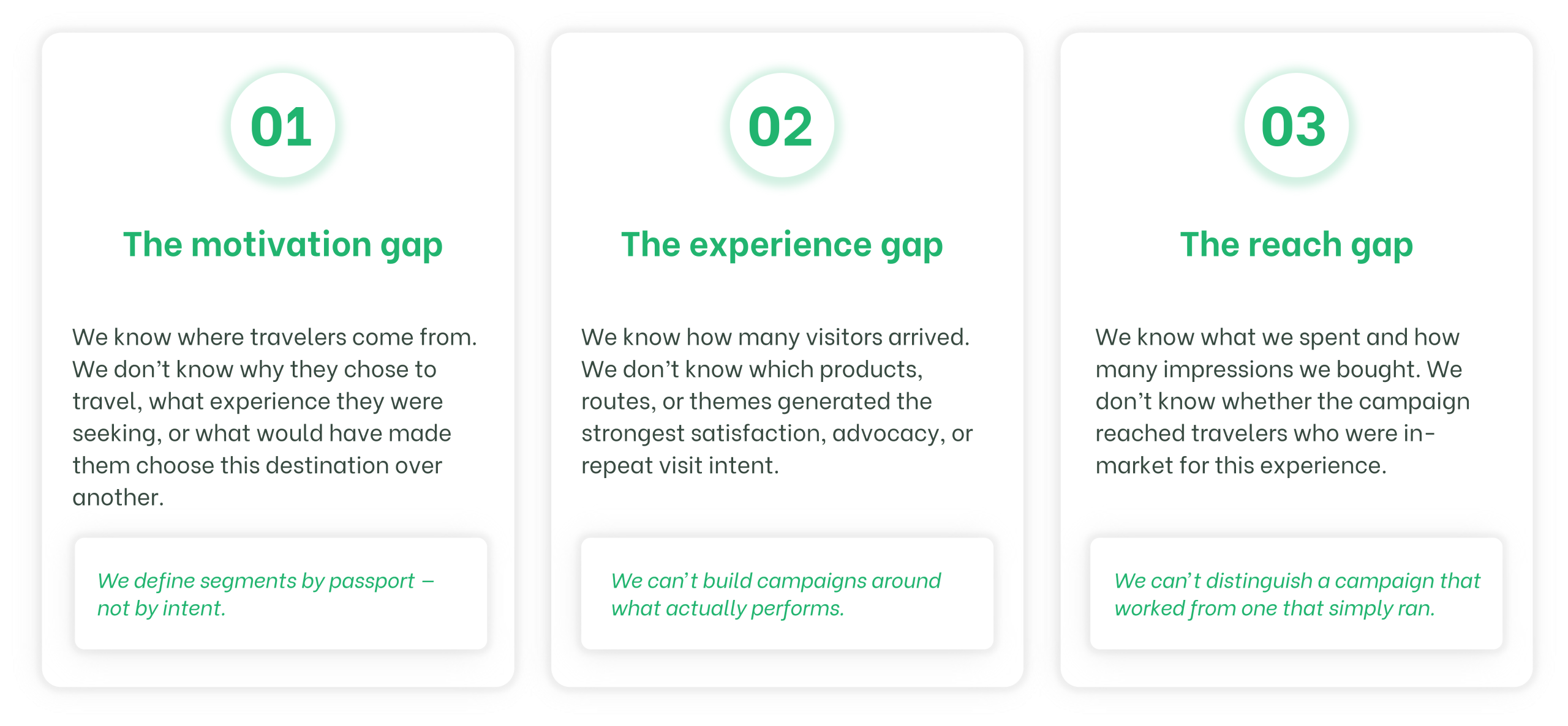
Destination marketing data gaps generally fall into three areas: motivation, experience, and reach. Together, they leave NTOs with a partial view of the traveler journey, forcing campaigns to rely on broad audience assumptions, generic messaging, and metrics that are difficult to connect to actual commercial outcomes.
1. The Motivation Gap
Most destination organizations know where their visitors come from. Far fewer can consistently explain what those travelers are actively seeking.
For decades, nationality has been one of the most convenient ways to define a tourism market. An NTO identifies Japan, Australia, Germany, or the United States as a priority market, studies historical arrivals, and builds campaigns around broad characteristics of travelers from that market.
The problem is that a passport is not a travel motivation.
Two travelers from the same market, even within the same age group, can have completely different reasons for traveling. One may be looking for cultural immersion and slow travel, while another prioritizes food, nightlife, luxury, or simply an affordable short-haul escape. A segment defined by nationality can tell marketers where travelers come from, but not what they are trying to accomplish with their next trip.
Without this level of tourism demand insight, marketers often work backwards from what they already know about the destination rather than what travelers are currently looking for.
2. The Experience Gap
Visitor volume is an important measure, but it is not the same as understanding the visitor experience.
A destination may know that international arrivals increased by 10 percent while having limited visibility into which routes, attractions, themes, or experiences contributed to that growth.
This matters because experiences are what destination brands actually market.
If cultural heritage is attracting strong interest but a particular heritage product is underperforming, the response should be different from a situation where the entire cultural proposition is losing relevance. Similarly, if travelers increasingly combine nature and local food in their trip planning, a destination needs to understand that connection rather than treating each attraction as a separate marketing asset.
The experience gap prevents NTOs from connecting visitor behavior with the destination’s individual products and propositions.
3. The Reach Gap
The third gap is the ability to connect marketing activity with behavioral outcomes.
Impressions, clicks, video views, and engagement rates can show whether a campaign generated attention. They cannot necessarily show whether the campaign changed destination consideration or influenced a booking.
This is particularly problematic for NTOs because the path from marketing exposure to travel is long and fragmented. A traveler may see a destination campaign, search for information several weeks later, compare destinations, and eventually book through a third-party platform.
If measurement stops at campaign reach, marketers can report strong performance while having little evidence that the campaign changed demand.
The question should therefore move from “How many people did we reach?” to “What changed because we reached them?”
Why Do These Destination Marketing Data Gaps Persist?
The problem is not simply that NTOs lack data. It is that the most valuable data often sit outside the traditional tourism research system, while public-sector research remains periodic, fragmented, and difficult to operationalize within fast-moving campaign cycles.
The private-sector data asymmetry
Commercial travel platforms sit much closer to traveler intent.
OTAs, booking engines, search platforms, and other digital channels observe behaviors that can indicate what travelers are considering before they arrive. Searches, availability checks, booking behavior, destination comparisons, reviews, and content engagement can provide a much more immediate view of demand than historical arrival statistics.
NTOs, however, typically do not have continuous access to all of these signals.
This creates a structural asymmetry. The organizations selling travel products can observe demand as it develops, while the organizations responsible for marketing destinations may still be making decisions based primarily on what happened months or years earlier.
The result is a timing problem.
By the time a destination identifies a shift through official statistics, the market may already have moved.
Research is often designed as a project, not an operating capability
Many destination organizations still depend on visitor surveys conducted every two or three years, supplemented by annual arrival statistics and informal feedback from tourism businesses and trade partners.
These sources remain valuable. They provide context that digital behavioral data cannot replace.
But they are not sufficient on their own for annual campaign decisions.
A traveler profile that was accurate three years ago may no longer describe today’s traveler. Motivations can change. Air connectivity can change. Competitor destinations can become more accessible. Economic conditions can alter willingness to travel and spending behavior.
When the research cycle operates every few years but the marketing cycle operates every year, campaigns inevitably inherit outdated assumptions.
The answer is not to abandon traditional research. It is to add a continuous layer of demand intelligence that can detect what is changing between major research projects.
This is not only a challenge for destination marketing. The same data limitations affect wider tourism planning and development, where outdated or fragmented information can lead to slower responses and poorly aligned investment decisions. For a broader look at why timely, multi-source data matters for destination planning, see Why Data Matters for Tourism Planning and Development.
Case Study: Assumption-Led vs. Demand-Led Marketing
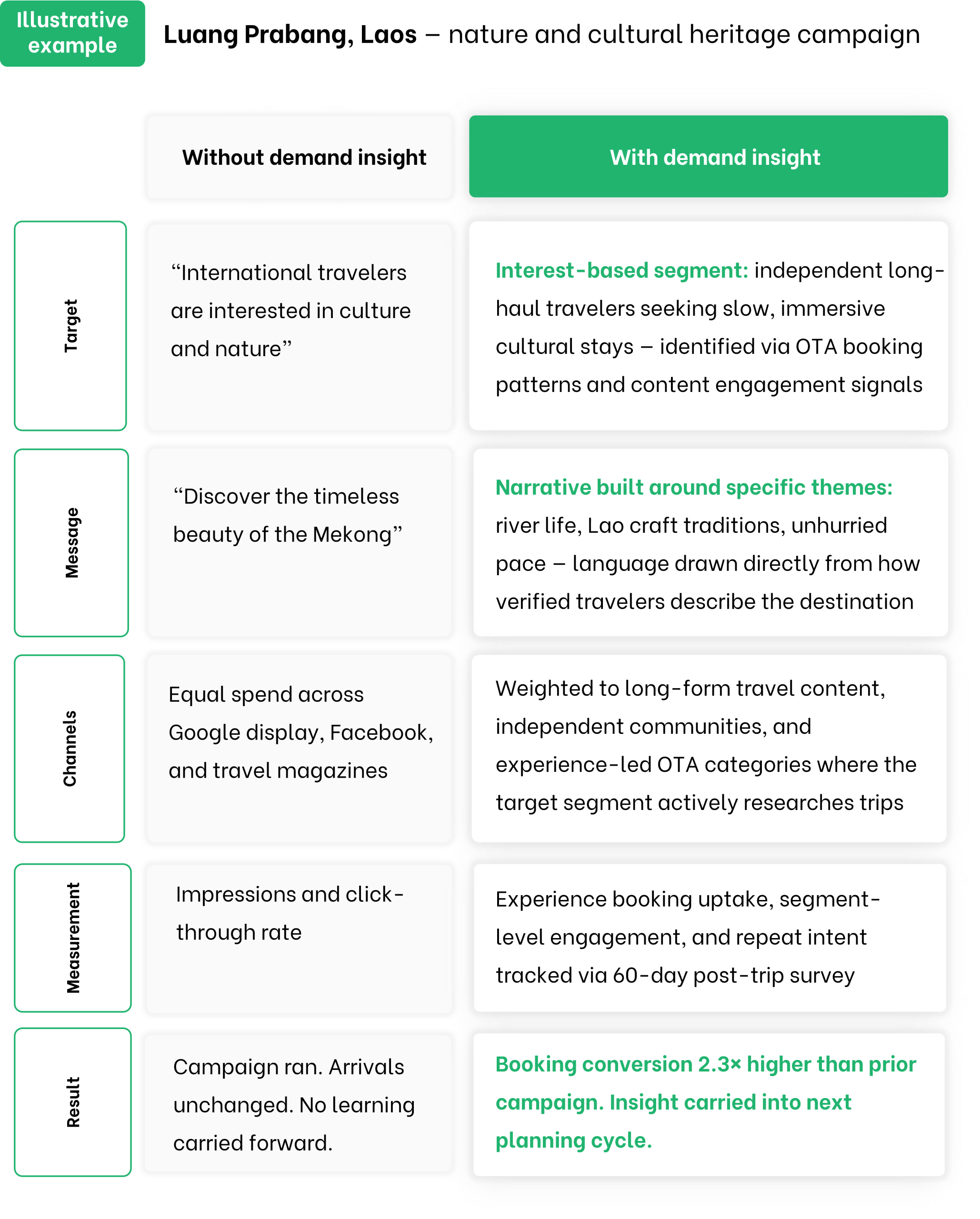
The difference between broad destination marketing and demand-led execution becomes clearer when the same destination proposition is approached with better insight into traveler demand. The Luang Prabang example shows how how understanding demand insights can change audience targeting, creative strategy, channel allocation, and ultimately campaign conversion.
An assumption-led campaign might start with a broad audience definition such as international travelers interested in Southeast Asia. The creative could focus on a generic destination promise: “Discover the timeless beauty of Luang Prabang.” Budget is distributed across broad display and print channels, with performance measured primarily through reach and impressions. Despite generating exposure, the campaign produced no change in arrivals.
The campaign may generate significant exposure. But if the underlying audience is too broad and the message is not connected to a specific traveler motivation, there is little reason to expect the campaign to change booking behavior.
In the example, the result was clear: arrivals remained unchanged.
A demand-led approach starts from a different question: which travelers are currently showing interest in the type of experience Luang Prabang can offer?
Instead of treating the entire long-haul market as one audience, the campaign can identify a more specific behavioral segment, such as independent long-haul travelers seeking slower, experience-led travel.
The creative then moves away from generic destination promotion and toward specific reasons to visit. River life, craft traditions, nature, cultural heritage, and the slower pace of the destination become part of a narrative designed around what the audience is seeking.
Channel investment can also follow the behavior of that audience, placing greater weight on platforms and environments where experience-led travel decisions are being researched.
The reported result was a 2.3x increase in booking conversions compared with the broad approach.
- Without demand insight
An assumption-led campaign might start with a broad audience definition such as international travelers interested in Southeast Asia. The creative could focus on a generic destination promise: “Discover the timeless beauty of Luang Prabang.” Budget is distributed across broad display and print channels, with performance measured primarily through reach and impressions. Despite generating exposure, the campaign produced no change in arrivals.
The campaign may generate significant exposure. But if the underlying audience is too broad and the message is not connected to a specific traveler motivation, there is little reason to expect the campaign to change booking behavior.
In the example, the result was clear: arrivals remained unchanged.
- With demand insight
A demand-led approach starts from a different question: which travelers are currently showing interest in the type of experience Luang Prabang can offer?
Instead of treating the entire long-haul market as one audience, the campaign can identify a more specific behavioral segment, such as independent long-haul travelers seeking slower, experience-led travel.
The creative then moves away from generic destination promotion and toward specific reasons to visit. River life, craft traditions, nature, cultural heritage, and the slower pace of the destination become part of a narrative designed around what the audience is seeking.
Channel investment can also follow the behavior of that audience, placing greater weight on platforms and environments where experience-led travel decisions are being researched.
The reported result was a 2.3x increase in booking conversions compared with the broad approach.
The broader lesson is more important than the individual result. Demand insights does not simply give marketers more data to include in a campaign report. It can change the campaign brief itself.
It helps answer three decisions before media is purchased: which travelers are most relevant, which aspects of the destination should be emphasized, and where those travelers are most likely to respond. That is the difference between using data to describe a market and using data to make marketing decisions.
How NTOs Can Operationalize Demand Insights
NTOs need to move demand insights from an occasional research project into a continuous operational capability. The objective is not to replace established tourism research, but to add timely behavioral signals that can inform audience selection, messaging, channel investment, and measurement before and during each campaign.
A practical demand-led approach should answer three questions before campaign launch.
1. Who are we speaking to?
The first question should no longer be simply, “Which origin market are we targeting?”
It should be, “Which travelers within that market are showing behaviors or interests aligned with our destination proposition?”
Origin markets remain commercially important. They influence media planning, partnerships, distribution, and market prioritization. But they should become one layer of segmentation rather than the entire segmentation strategy.
Traveler intent data can help identify audiences based on what they are looking for, how they behave, and which experiences they are considering. This creates more useful segments for campaign execution.
For example, “Japanese travelers” is a market.
“Independent Japanese travelers actively interested in slow travel, heritage, and local food experiences” is a marketing audience.
The second description gives a campaign team something it can actually act on.
2. What do we say?
The second question is about the connection between traveler motivation and destination assets.
A destination does not need to promote every attraction equally. It needs to understand which assets are most relevant to the audiences it is trying to attract.
If demand signals show rising interest in slow travel, for example, the campaign strategy should investigate which local experiences genuinely support that motivation. If cultural discovery is gaining attention, the destination should identify the specific cultural products that can credibly fulfill that demand.
This is where tourism demand insight becomes useful for creative strategy.
Data should not replace storytelling. It should help determine which stories deserve investment.
3. Did it work?
The final question is the most important and the one most often weakened by traditional campaign reporting.
A campaign should not be considered successful simply because it generated reach.
NTOs need to establish what behavioral change they expect to see. Did destination consideration increase? Did relevant searches grow? Did engagement with priority experiences increase? Did travelers move further toward booking? Did repeat intent change?
The exact metrics will vary by campaign objective and available data. The principle remains the same: measurement should move closer to traveler behavior and commercial outcomes.
A stronger measurement framework establishes a chain between marketing activity and behavioral signals. It asks whether demand increased among the intended audience and whether the destination gained consideration relative to competing destinations.
This creates a much stronger basis for deciding whether to scale, change, or stop a campaign.
Close the Data Gap Before Spending More on Media
Closing destination marketing data gaps is not an academic research exercise. It is a practical requirement for NTOs and DMOs that need to understand their audiences, allocate marketing budgets effectively, and demonstrate whether campaigns are influencing traveler behavior. Arrival statistics and periodic research remain valuable, but they cannot answer every question a modern destination marketer needs to make.
The real question for NTOs is no longer whether they have enough data. It is whether their data is timely and actionable enough to influence the decisions that matter. Talk to Outbox team today to strengthen your destination’s data and marketing strategy!