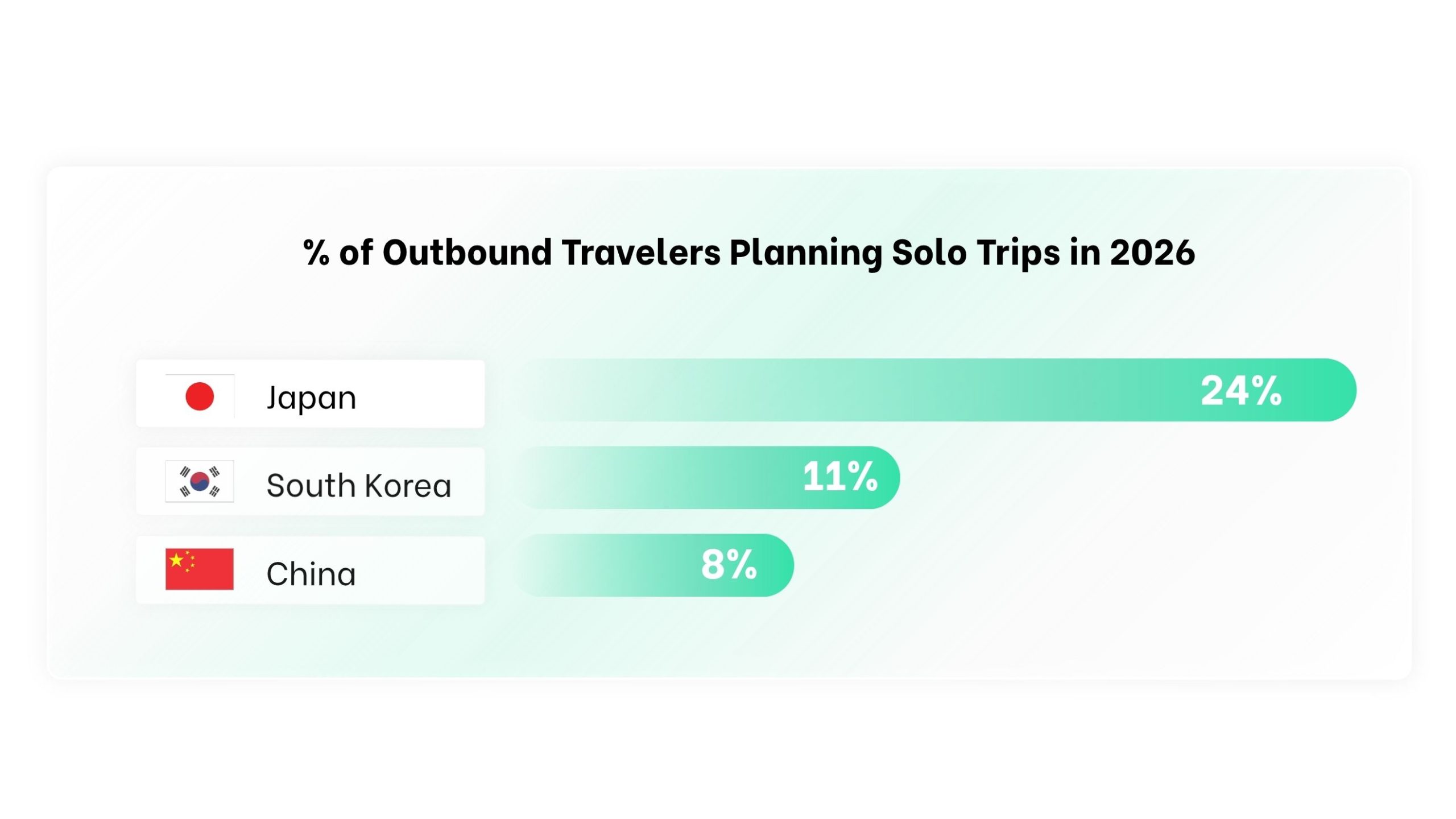
Japanese solo travelers have become one of the most distinctive segments within Japan’s outbound travel market. New findings from Asia Outbound Traveler Profiles 2026: Northeast Asia Edition, powered by Outbox’s Asia Travel Sentiment (ATS) platform, show that 24% of Japanese outbound travelers now plan to travel alone—the highest incidence among Northeast Asia’s major source markets. By comparison, the regional average stands at 13%, followed by South Korea at 11% and China at just 8%. Put simply, Japanese travelers are nearly twice as likely to travel alone as the average Northeast Asian traveler and roughly three times more likely than their Chinese counterparts.
This is not simply a short-term shift in travel behavior. In 2024, Euromonitor International identified Japan as the world’s leading solo travel market, reporting that Japanese consumers were the most likely among 39 surveyed countries to take vacations alone. Combined with Outbox’s latest data, the evidence suggests that solo travel has become an established part of how many Japanese travelers choose to explore the world.
Building on that broader industry context, this article examines what defines today’s Japanese solo traveler—from trip frequency and travel style to accommodation preferences, spending habits, and regional travel preferences. Together, these insights reveal what destinations, tourism boards, hotels, airlines, and travel brands need to understand to better engage one of Asia’s most independent outbound travel segments.
The Modern Japanese Solo Traveler
Japanese solo travelers travel often
Nearly half of Japanese solo travelers, 49%, intend to take more than one international trip within the next six months. This is not a once-a-year vacationer. They are repeat travelers who treat international trips as a regular part of life rather than a rare indulgence.
Japanese's solo trips are short.
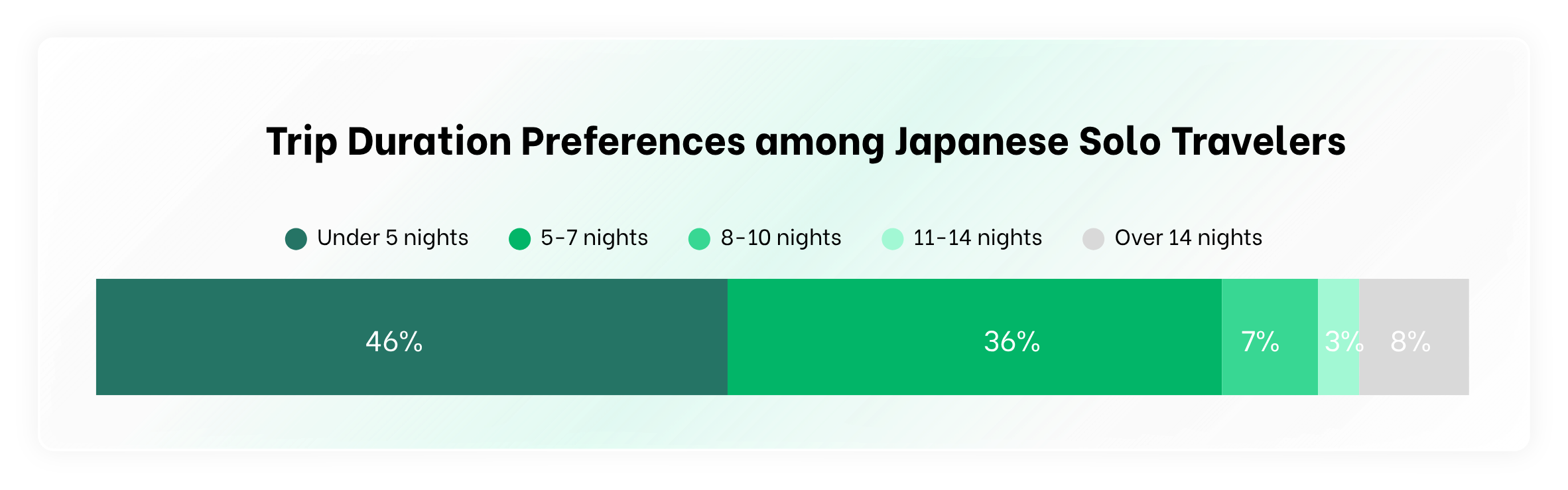
Almost half, 46%, plan trips shorter than five nights. Combined with the high trip frequency above, a pattern emerges: Japanese solo travelers appear to favor frequent, shorter getaways over occasional extended vacations. Flexibility and ease of planning seem to matter more than maximizing time away. Japan’s calendar of public holidays throughout the year may also make shorter overseas trips easier to fit into busy schedules.
Solo travelers in Japan plan their trips independently.
An overwhelming 96% of Japanese solo travelers travel independently rather than through packaged tours. This is a market that wants control over its own itinerary, and it has the confidence and access to travel information needed to arrange trips without relying on tour operators.
Solo travelers seek value for money in accommodation bookings.
When it comes to where they stay, 31% of Japanese solo travelers prefer 2 to 3-star hotel chains, the largest single accommodation category in the data. This points to a traveler who prioritizes reliability, cleanliness, and convenient location over luxury positioning. Solo travelers are not necessarily looking to economize at every turn, but they are pragmatic about where their money goes.
Japanese solo travelers are budget-conscious, not budget-only.
Trip budgets reflect a similar pattern. The most common spending brackets are USD 1,501 to 2,000 (32%) and under USD 1,000 (24%). Together, these figures describe a market anchored in the budget-conscious and mid-range segments rather than the premium end. This does not mean Japanese solo travelers are simply chasing the lowest price. It means they are looking for strong value: experiences and services that feel worth the money, rather than the cheapest option available or the most extravagant one.
A strong preference for regional travel.
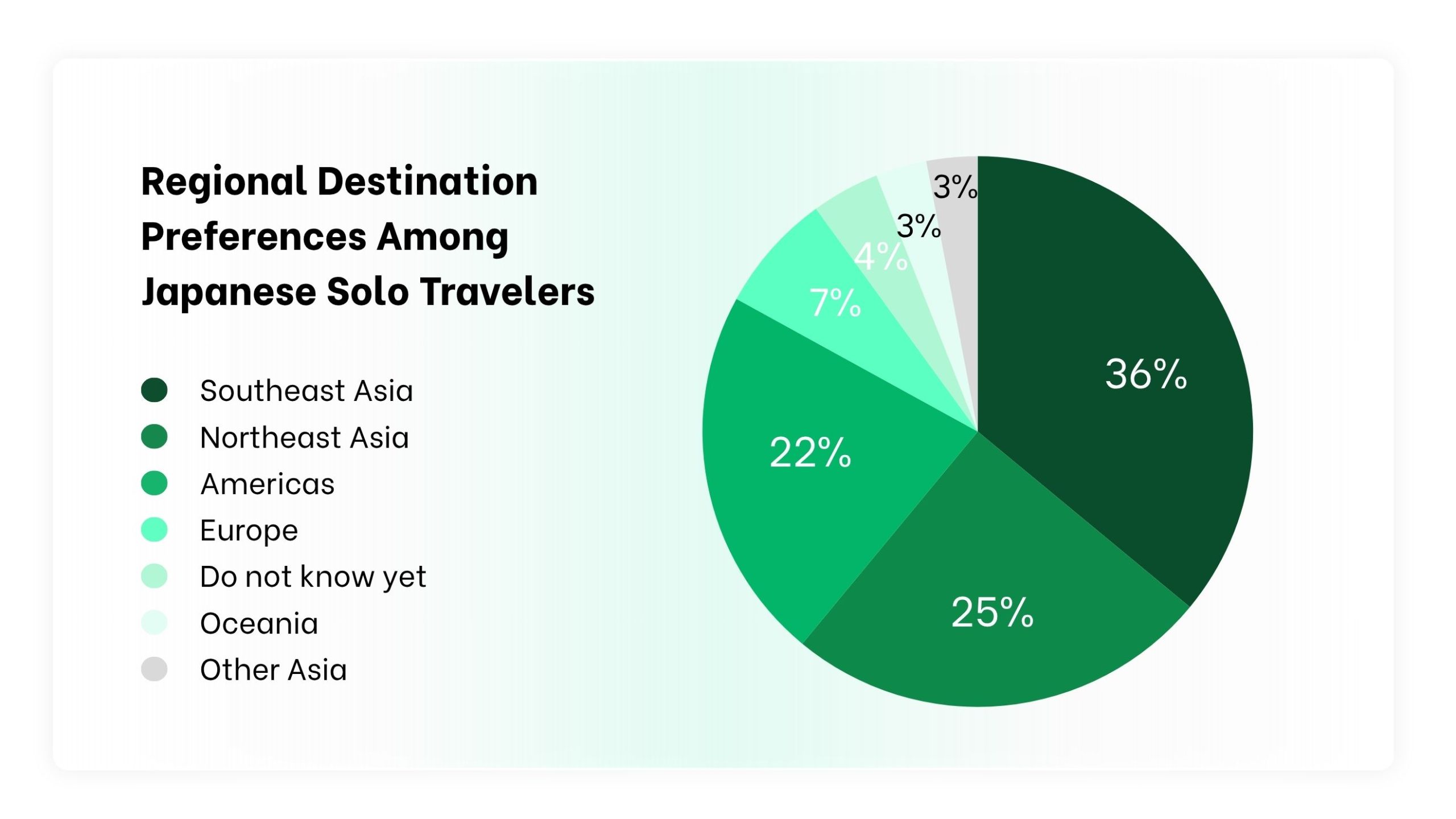
Southeast Asia is the most popular destination region, attracting 36% of intended trips, followed by Northeast Asia (25%) and the Americas (22%). The strong interest in nearby Asian destinations complements the broader travel profile, suggesting Japanese solo travelers value destinations that are accessible, convenient, and well suited to shorter independent trips.
Taken together, these behaviors describe travelers who appear to optimize for convenience rather than extravagance. They travel often enough to become experienced decision-makers, organize trips on their own terms, and allocate budgets carefully across multiple international journeys throughout the year.
Winning this market may depend less on premium positioning and more on delivering a frictionless travel experience—competitive air connectivity, convenient locations, transparent pricing, reliable accommodation, and flexible booking options that support independent trip planning.
For destinations, tourism boards, hotels, airlines, and travel brands, these behavioral patterns matter because they describe a traveler who cannot be won over with generic messaging alone. This is a market that rewards specificity: clear value propositions, dependable service, and marketing that speaks directly to the realities of traveling alone. As Japan’s outbound travel market continues to grow, the destinations and brands that understand these nuances, rather than treating solo travelers as an afterthought within broader tourism strategy, will be best positioned to capture this influential and expanding segment.
This article is based on insights from Asia Travel Sentiment (ATS), Outbox’s proprietary platform for tracking outbound travel intentions, preferences, and behaviors across Asia’s key source markets. Want to explore how traveler sentiment is evolving across your target markets? Get in touch to request a demo and discover how ATS can support smarter tourism and business decisions.