
What Is Travel Intelligence?
Turning fragmented travel data into genuine travel data intelligence is harder than it sounds. Tourism organizations, hotels, airlines and other travel businesses have access to more data today than at any point in the industry’s history. Search trends, booking patterns, traveler sentiment, mobility data, pricing signals, destination performance metrics — the volume and variety of available information continues to expand every year.
Yet more data does not automatically lead to a better understanding of the market. What matters is having timely, relevant and sufficiently granular information that can help decision-makers make sense of what is happening in the market. The OECD’s Tourism Trends and Policies 2026 highlights this growing importance of timely, granular and reliable tourism data for better decision-making.
Part of the reason is that different datasets answer different questions. A search trend tells you something different from a booking pattern. A sentiment score tells you something different from a pricing shift. Each dataset, viewed on its own, offers a narrow and incomplete view of what is actually happening in the travel ecosystem.
The real challenge for travel and hospitality professionals is not access to data. It is understanding how these different signals relate to one another. This is where the idea of Travel Intelligence comes in.
Travel Is a Multi-Layered System
Travel does not happen through a single measurable event. It unfolds across a sequence of stages, each shaped by different factors.
A traveler forms motivations and preferences long before booking anything. Interest develops, often shaped by inspiration, past experience or changing circumstances. Destinations are considered and compared. A decision is made. The trip happens. Along the way, the traveler interacts with attractions, accommodations, transportation and local experiences, and forms impressions that show up later as reviews, feedback or repeat behavior.
At the same time, none of this happens in isolation. Supply, pricing, capacity, seasonal events and broader economic conditions all shape how that journey unfolds, independent of what any individual traveler wants or intends.
Because travel is shaped by so many interacting factors, understanding it requires looking across multiple layers of data rather than relying on any single metric. A booking number alone cannot explain why demand shifted. A sentiment score alone cannot explain where travelers are going instead. Real understanding comes from looking at how these layers move together.
The Five Layers of Travel Intelligence
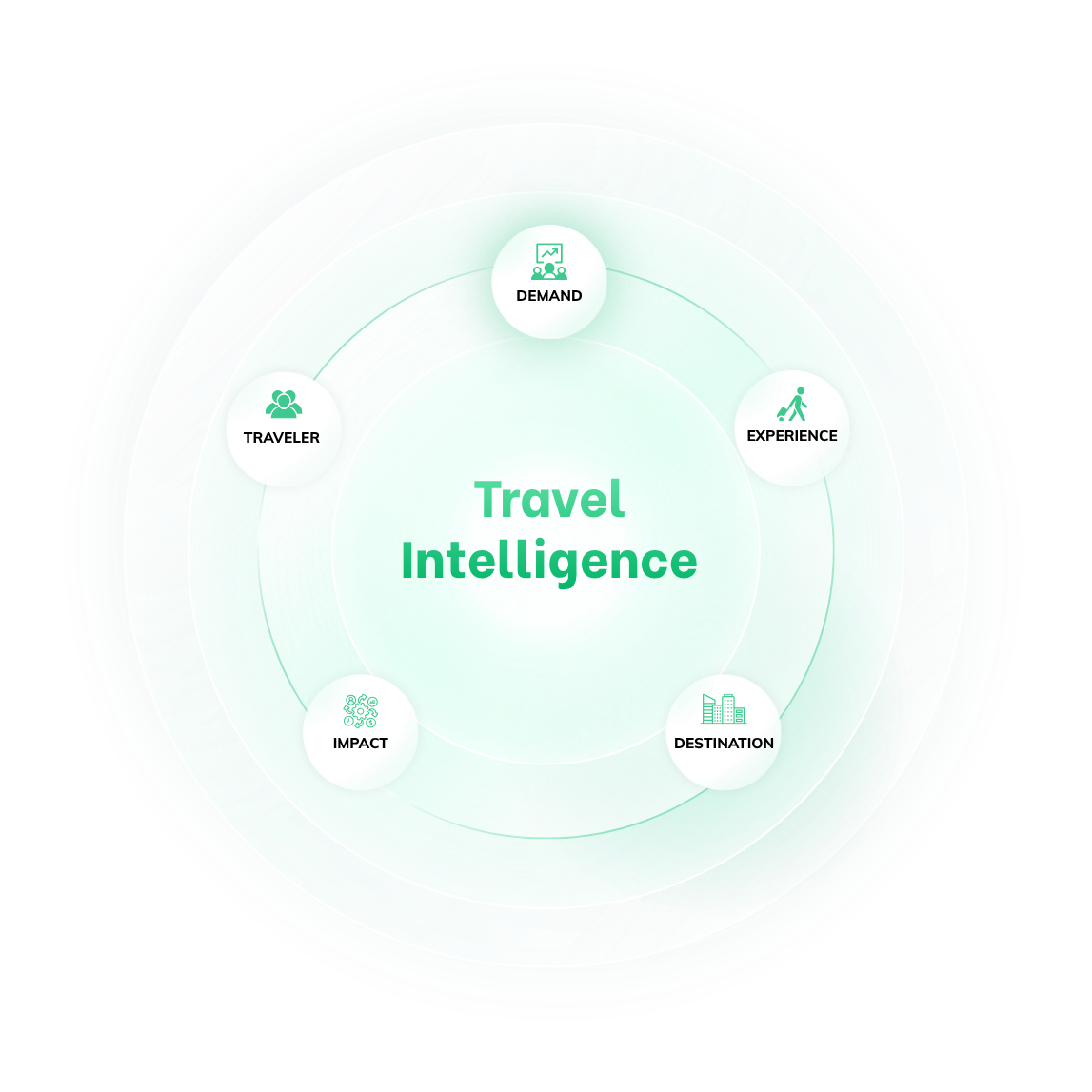
One practical way to think about the major dimensions that contribute to travel intelligence is as five interconnected layers. This is not intended as a rigid or universal taxonomy — travel data is too varied for any single framework to capture every source. It is simply a useful lens for organizing how different types of travel data relate to one another.
01. Traveler — Who is traveling, and what shapes their choices?
This layer includes traveler profiles, demographics, preferences, motivations, sentiment and behavior. It answers questions about who is moving through the travel ecosystem and what shapes their choices. It draws on sources like surveys, loyalty data, CRM records and social listening.
02. Demand — What are travelers interested in, and how does that translate into travel?
Demand tracks the level and direction of traveler interest in a destination, from emerging interest and intent through to booking activity. It brings together a range of demand signals, including digital behavior, search activity, social engagement and booking patterns, to show how interest is building, shifting or translating into commercial demand. he strength of that demand is influenced by factors such as availability, pricing, connectivity, seasonality, economic conditions, events and policy changes. A range of search-trend and market-monitoring tools now track this kind of signal, showing interest in a destination rising or falling against prior periods.
03. Destination — Where is travel activity happening?
Destination data answers where travelers are going: destination interest, source markets, visitor flows, performance and competitive positioning relative to comparable places. This typically comes from arrival and visitor-flow statistics, geographic search interest and destination benchmarking reports. It shows not just where demand is concentrated today, but how that concentration is shifting over time.
04. Experience — What are travelers doing and experiencing there?
Experience data captures what happens once a traveler arrives: interactions with attractions and activities, mobility patterns, reviews and satisfaction. Review platforms, footfall and mobility data, and post-trip surveys are typical sources. This layer is what reveals whether the actual trip lived up to what the traveler expected before they left.
05. Impact — What does that activity mean for the destination?
Impact looks at what tourism activity means for the destination and the people, economy and environment around it. It considers the economic contribution of tourism, its effects on local communities, and its environmental footprint, helping destinations understand not only how much tourism they generate, but what that activity means for the places where it takes place.
None of these layers is more important than the others. Their value comes from how they complement one another. Demand data without destination context tells you interest is rising, but not where. Experience data without market context tells you satisfaction is falling, but not why. It is the relationship between the layers, not any single one, that produces a fuller picture.
Data Is Not Yet Intelligence
This distinction matters more than it might seem.
Travel data provides individual facts and measurements. It tells you what happened: a number of searches, a volume of bookings, a rating, a percentage change. On its own, a data point is accurate but limited. It describes a moment without explaining its significance.
Travel intelligence connects different signals and places them into context. It asks a different question: what does this mean? Why is this happening? What is it likely connected to?

Intelligence is not simply a larger dataset or a more advanced dashboard. It comes from the work of:
- connecting signals across different layers,
- identifying relationships between them,
- adding context that explains why a pattern exists,
- recognizing patterns that repeat or diverge from expectations,
- monitoring how those patterns change over time,
- and translating all of this into an understanding that can actually inform a decision.
A dashboard full of metrics is not intelligence until someone — or some process — does this connective work.
From Measurement to Understanding
It can help to think of this as a progression across three levels.
Measurement: What happened? This is the most basic level — a static fact captured at a point in time. Useful, but limited in isolation.
Monitoring: What is changing? This adds a time dimension. Instead of a single snapshot, monitoring tracks how a metric moves, rises, falls or fluctuates.
Intelligence: What does that change mean? This is where connection and context come in. Intelligence takes a change identified through monitoring and relates it to other layers of data to explain its significance.
Each level has its own value, and none replaces the others. But it is worth being clear-eyed about what this progression does and does not offer. Travel intelligence is not primarily about predicting the future with certainty. It is about developing a clearer, more connected view of the present travel environment — one detailed enough that emerging patterns and their likely implications become easier to see.
Why Travel Intelligence Matters
The value of connecting these layers shows up differently depending on where you sit in the travel ecosystem.
For destinations, it means understanding changing traveler interest, shifts in source markets, how the destination is perceived, and how it compares to competing destinations.
For hospitality businesses, it means understanding demand alongside guest behavior, pricing context and experience performance, rather than looking at any one of these in isolation.
For airlines, it means understanding market interest, travel patterns and destination demand together, since passenger behavior rarely shifts for a single, isolated reason.
For travel businesses more broadly, it means treating customers, markets and experiences as connected parts of one ecosystem rather than separate reporting lines. WTTC’s economic impact research is one example of trying to quantify that ecosystem at scale, across GDP, employment and spending.
In each case, the practical benefit is the same: decisions grounded in a fuller picture tend to hold up better than decisions made from a single metric viewed in isolation.
Getting to Real Travel Data Intelligence
The future of travel intelligence is not simply about collecting more data. Most organizations already have more data than they can fully use. The more meaningful shift is toward developing real travel data intelligence — a clearer understanding of how different signals connect to reveal what is actually happening, and why.
Travel data gives you pieces of the picture.
Travel intelligence helps you see how those pieces fit together.
Curious what this could look like for your organization? Contact Outbox to talk through tailored intelligence solutions built around your data, your markets and your goals.