

Travel demand signals are the clues left behind before demand ever shows up as a number. Long before a booking is confirmed or an arrival is counted, travelers search, talk, compare prices and share experiences — and each of those actions leaves a trace. This article looks at where those traces come from, what they can tell businesses, and why understanding travel demand today means looking well beyond the outcomes that appear in a monthly report.
Bookings. Arrivals. Occupancy. Revenue. These are the numbers most travel businesses use to describe demand, and for good reason: they are concrete, comparable and tied directly to commercial performance. But by the time they appear in a dashboard, they already describe something that has finished happening. The interest, comparison and decision-making that produced that outcome took place earlier, often across channels that outcome metrics were never built to capture.
That earlier activity is what this article refers to as travel demand signals.
What are travel demand signals?
Travel demand signals are observable changes in traveler behavior, market conditions and visitor activity that provide context on how demand is developing.
They can emerge at different points across the travel journey and from different parts of the travel ecosystem: search engines, social platforms, distribution and pricing systems, and the reviews and feedback travelers leave once a trip is underway.
Some signals reflect what travelers are interested in. Others show what they are talking about, how the market is responding or what visitors are experiencing.
For example:
- Search behavior can reveal what travelers are researching.
- Social activity can show what is attracting attention and shaping perception.
- Price and availability can provide context on how the market is responding.
- Visitor activity and reviews can reveal what travelers are experiencing.
Together, these signals provide different perspectives on how travel demand is developing across destinations, markets and travel periods.
The following four signal groups offer a useful starting point for understanding what this digital traveler behavior can reveal.
The four signals behind travel demand
Demand signals tend to cluster around four broad categories: what travelers are searching for, what they are talking about, how the market is responding, and what visitors experience once they arrive. Each captures a different layer of the same underlying picture.
01. Search: What are travelers looking for?
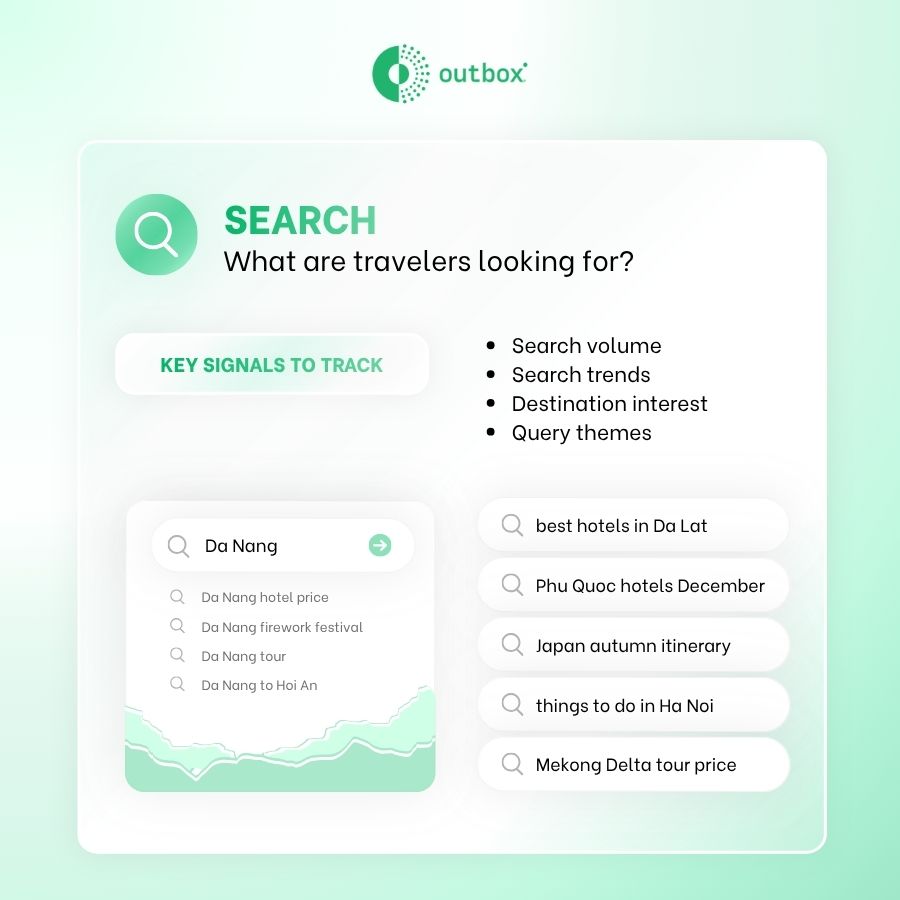
Search behavior provides a window into what travelers are actively researching.
People search for destinations, hotels, itineraries, attractions, travel periods and experiences as they explore potential trips. Changes in this behavior can therefore provide useful context on where interest is emerging or shifting.
Consider searches such as:
- “Japan autumn itinerary”
- “Phu Quoc hotels December”
- “best family resorts Vietnam”
- “Thailand 5 day itinerary”
- “where to travel in October”
The value is not simply in counting searches. It is in understanding how search behavior changes.
A destination receiving more attention may warrant closer monitoring. A growing interest in a particular travel period may highlight an emerging opportunity. A rise in searches around wellness, family travel or food experiences can reveal themes that are becoming more relevant to travelers.
For marketers, these patterns can inform content and communication priorities.
For destination organizations, they can provide another perspective on which markets, periods or travel themes are gaining attention.
But search interest should not be treated as a direct measure of bookings. Someone searching “where to travel in October” may be three months from a decision, comparing options for a trip they never take, or planning on behalf of someone else entirely. Search is best read as a signal of attention and consideration, not commitment.
02. Social: What are travelers talking about?
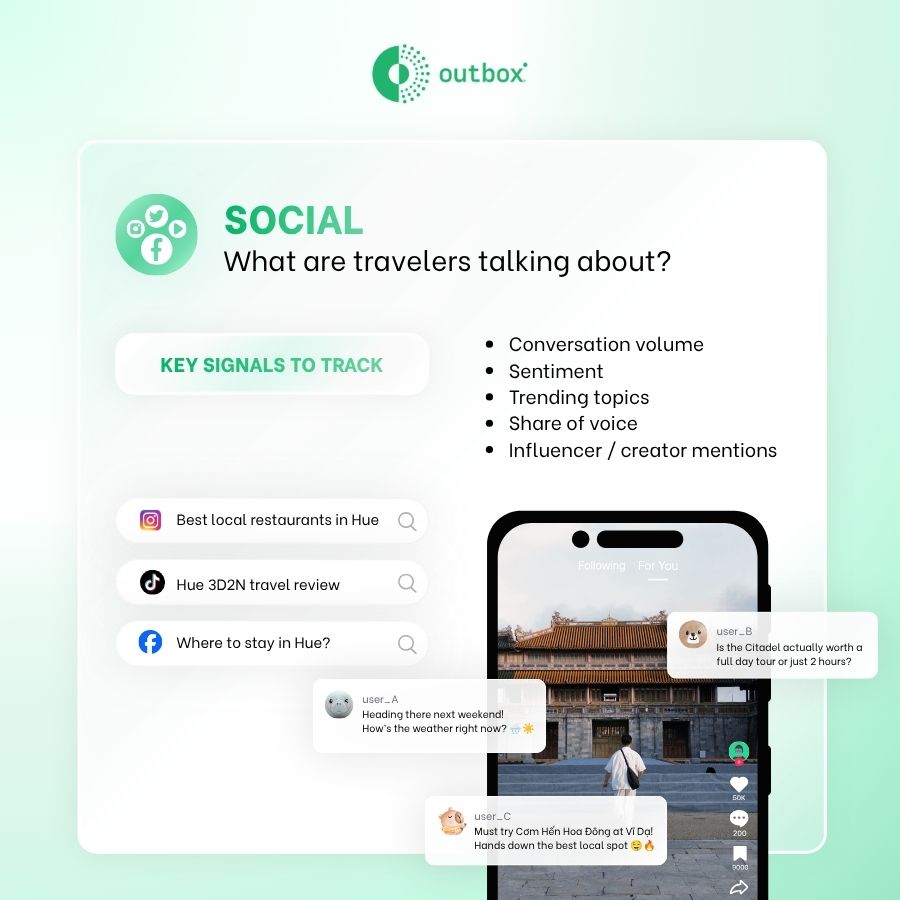
Social platforms capture something outcome metrics rarely do: the conversation happening around a destination, hotel or experience, often before, during and after a trip. This includes commentary that may never translate into a formal review or survey response.
Relevant signals can include:
- Volume of conversation about a destination or property
- Sentiment — whether the tone is positive, negative or mixed
- Trending topics, such as a new attraction, a food scene, or a weather event
- Share of voice relative to competing destinations
- Mentions from creators or influencers with meaningful reach
- How conversation volume and tone change over time
Travelers may discuss a new attraction, share a hotel experience, ask about weather conditions or debate whether a destination is becoming overcrowded.
Travel trends can also emerge through creators and online communities, with conversations developing around themes such as wellness, food, family travel, outdoor activities or major events.
The nature of these conversations can change as well.
A destination may see increasing discussion around a new attraction, while another may experience a shift toward conversations about value, accessibility or visitor experience.
Social signals capture this layer of traveler behavior and destination perception, providing a view of what is receiving attention and how the conversation is evolving.
03. Supply: How is the market responding?
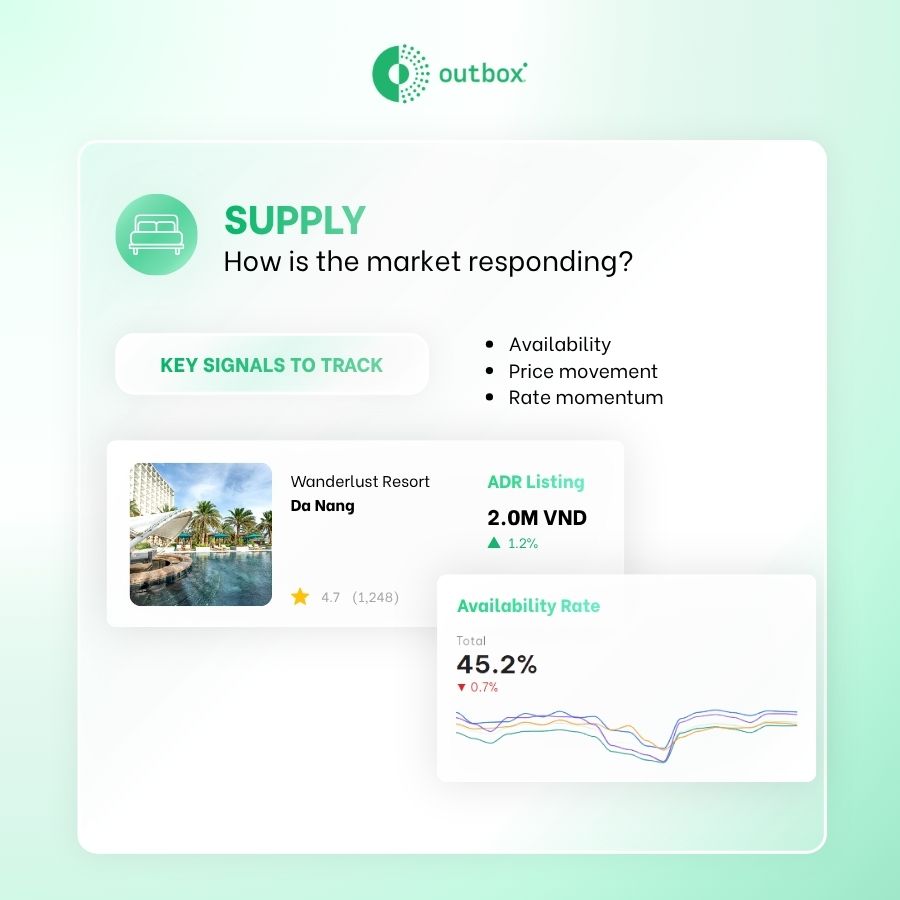
Demand does not exist independently from the market around it.
Hotels adjust rates, rooms become unavailable, inventory changes and new properties enter or leave the market, creating another set of signals around changing market conditions.
Relevant signals can include:
- Price movement
- Rate momentum
- Availability
- Availability compression
- Inventory changes
- New openings and closures
- Market pressure
For example, hotel rates may change significantly around a major event while availability narrows across a destination. In another market, inventory may expand while prices remain relatively stable, creating a very different set of market conditions.
Supply signals provide the market-side perspective on travel demand and travel market trends, capturing how accommodation and other parts of the tourism supply are changing.
04. Experience: What are visitors experiencing?
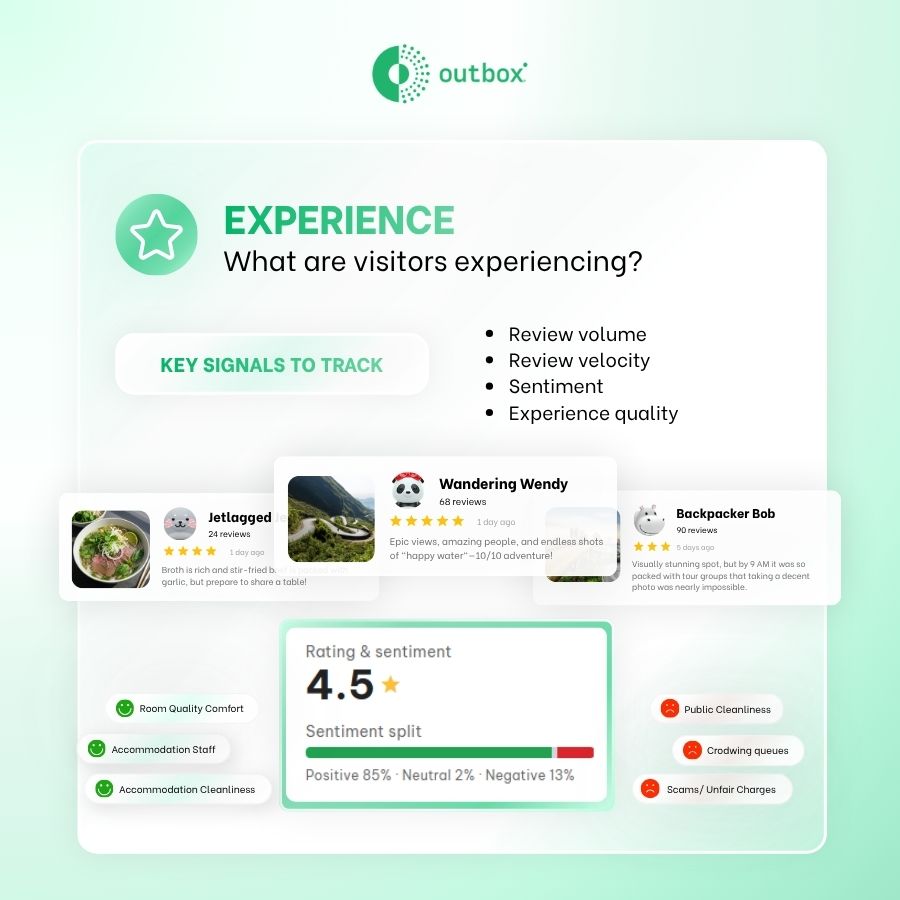
The travel journey does not end when a traveler arrives. Visitors generate another layer of digital data through reviews, ratings, conversations and activity around destinations, attractions, hotels and other tourism businesses.
Relevant signals can include:
- Review volume
- Review velocity
- Sentiment
- Visitor activity
- Experience quality
- Recurring themes in visitor feedback
Travelers may comment on service, food, attractions, accessibility, cleanliness, overcrowding, waiting times or other aspects of their experience.
The volume and nature of this feedback can change over time.
For example, a destination may see more review activity as visitor activity increases, while particular experience themes become more prominent in the conversation.
Experience signals therefore provide a view of what happens after travelers engage with a destination or business.
Travel Demand Signals Across the Travel Journey
Signals do not all appear at the same moment. Different signals tend to surface at different stages of the travel decision journey, which is one reason reading them together matters.
- Inspiration. Travelers are open to ideas and not yet committed to a destination. Social conversation, creator content and broad searches such as “where to travel in October” often dominate here. These signals point to attention and perception.
- Research and planning. Searches become more specific: itineraries, neighborhoods, family-friendly options, month-by-month comparisons. Search signals can show which destinations and themes are moving into serious consideration.
- Decision and booking. Travelers compare prices and check availability. Supply signals such as rate momentum and availability compression become more visible, showing how the market is responding as decisions are made.
- Travel and stay. Visitor activity rises and experience signals begin to form, from review activity to conversations about crowds, weather and service.
- Sharing and reflection. Reviews, photos and recommendations flow back into the ecosystem, shaping the inspiration and research of the next traveler.
This is not a fixed sequence. Journeys are rarely linear, and timing varies by market and trip type. A last-minute domestic weekend may compress inspiration, planning and booking into a day. A long-haul family holiday may unfold over months. Social buzz can appear after a price change as easily as before one, and experience signals from past visitors can shape the inspiration of future ones.
So the journey should not be read as a promise that search always comes first or that any early signal leads to a booking. It is a way of asking where in the decision process a given signal is likely to sit, and what it can tell you at that point.
From Travel Demand Signals to Travel Intelligence
Understanding travel demand requires looking beyond the point at which a trip is booked or a visitor arrives. The more useful question is how demand is developing along the way: where traveler interest is building, how the market is responding, and whether that interest is translating into actual travel and experience.
At Outbox, we apply this approach to travel intelligence by bringing multiple demand signals together and tracking how they evolve over time. Travel Demand Monitor (TDM), part of Outbox Intelligence, turns this approach into a dedicated dashboard that gives businesses an ongoing view of travel demand across destinations, combining digital traveler behavior, market supply and visitor experience in one place.
For teams looking to move beyond isolated data points and build a more continuous understanding of their market, TDM provides a practical way to monitor the signals behind changing demand.
Interested in learning more about Travel Demand Monitor? Contact Outbox to explore the platform and how it can support your business.