
Travel demand is reflected not only in where travelers show interest or how accommodation markets are changing, but also in the activity and experiences recorded through visitor feedback. Online reviews provide an additional layer of market intelligence, revealing how visitor engagement evolves and how destinations are perceived through actual travel experiences.
The Experience Activity Index (EAI), part of Vietnam Travel Demand Monitor (VTDM) by Outbox Intelligence, brings these signals together through review volume, ratings and sentiment. It helps tourism and hospitality businesses track changes in visitor activity, assess destination performance and identify the experiences shaping visitor perceptions.
This guide explores how EAI works, what information is available through its dashboard, and how businesses can use review data to better understand destination performance and identify areas for action.
What Is the Experience Activity Index (EAI)?
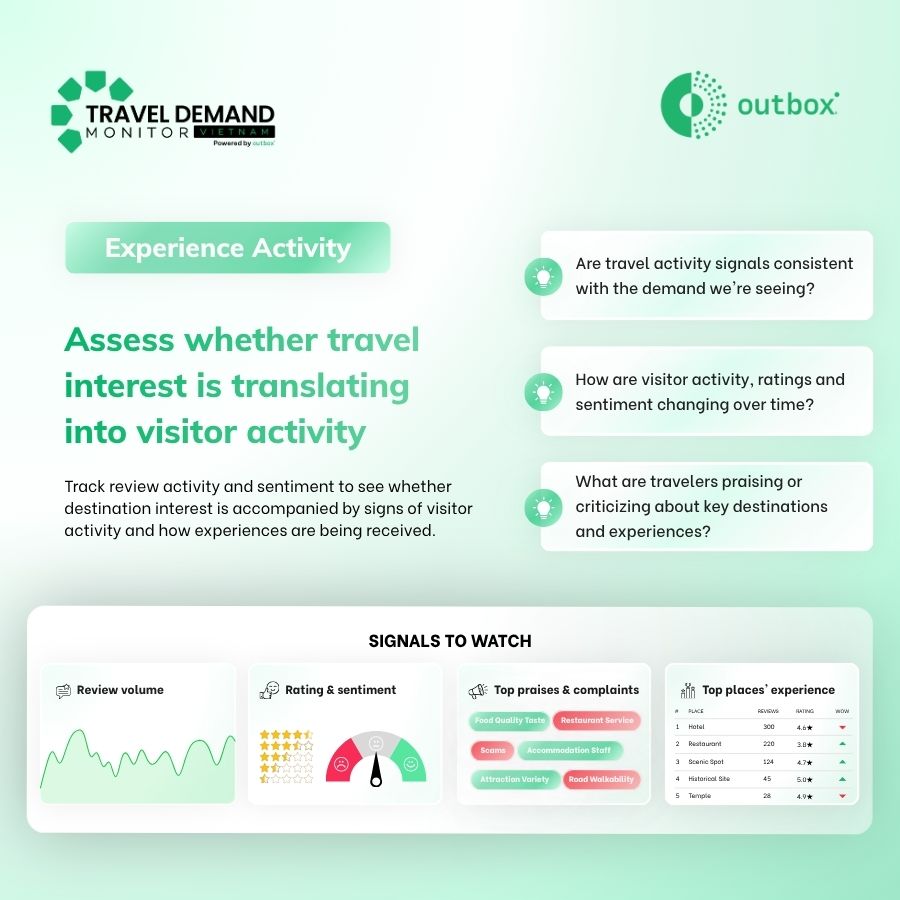
The Experience Activity Index (EAI) tracks visitor activity and destination experiences through online review data. It combines three key dimensions: review volume, review momentum, and ratings and sentiment, offering a broader view of how visitors are engaging with and evaluating destinations.
Review volume and momentum help users understand the level and pace of review activity over time, providing an indication of visitor engagement across destinations. Meanwhile, ratings and sentiment reveal how visitors perceive their experiences, highlighting positive feedback as well as areas of dissatisfaction.
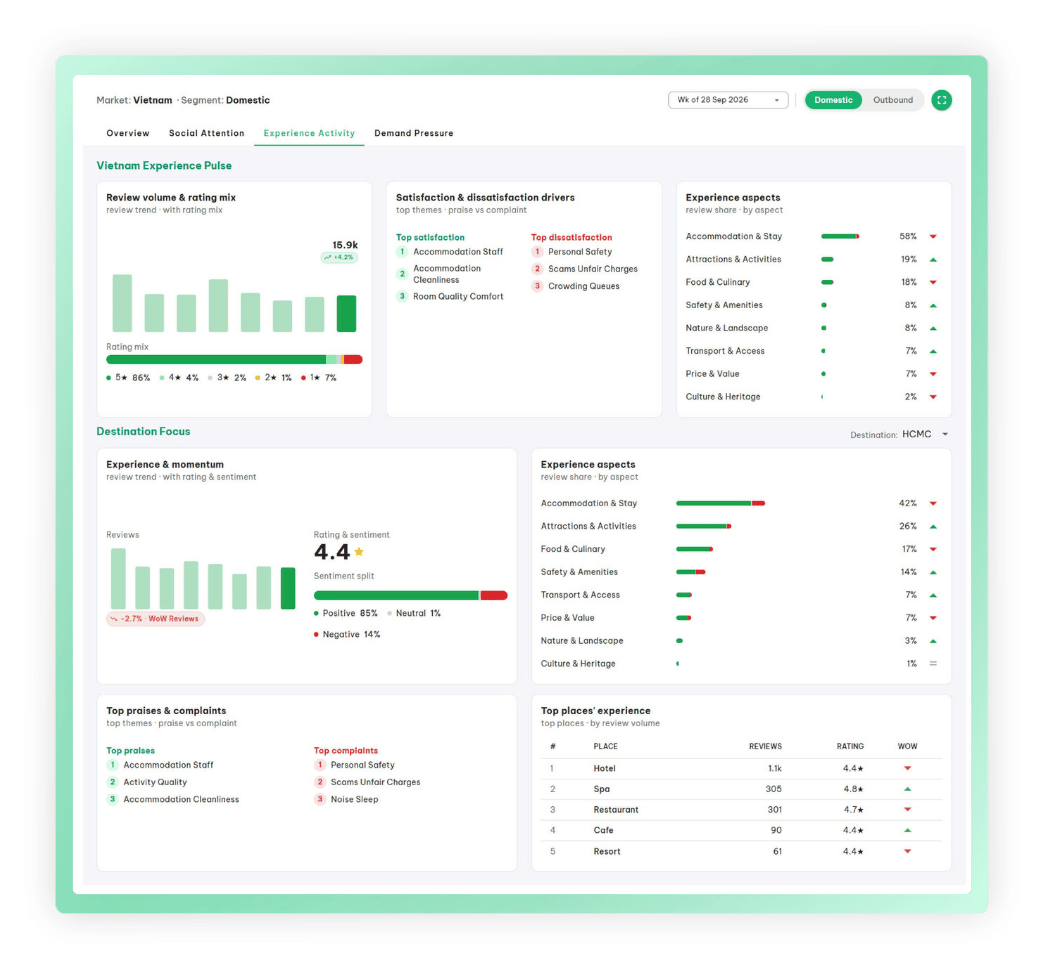
The Experience Activity tab brings these dimensions together, allowing users to explore visitor feedback across different aspects of the destination experience. From broader patterns in ratings and sentiment to feedback on specific places and experiences, the dashboard helps identify what visitors appreciate, where perceptions are less positive, and how these patterns vary across destinations. This may include feedback on areas such as accommodation, food, nature and price and value, among other aspects of the visitor experience.
Updated weekly, the EAI covers Vietnamese traveler markets across both domestic and outbound destinations. Its domestic coverage spans all 34 provinces and centrally governed cities in Vietnam.
How to interpret it: Online reviews provide an indication of visitor activity and experience, but they do not represent the total number of visitors or confirmed travel bookings. Review patterns should therefore be considered alongside other market indicators to build a more complete understanding of destination performance.
Questions Experience Activity Helps You Answer
- Is growing online interest accompanied by more visitor activity?
- How are visitor activity, ratings and sentiment changing over time?
- What are travelers praising or criticizing about key destinations and experiences?
- Which categories of places are earning the strongest reviews?
What You Can See in the Experience Activity Dashboard
Is visitor activity picking up or slowing down?
Track review volume over time to see whether visitor activity is picking up or cooling off, and whether ratings are moving with it.
What are visitors saying about their experiences?
Explore the distribution of ratings and sentiment to understand how visitors evaluate their experiences. See whether feedback is predominantly positive, negative or mixed, and identify changes in overall visitor perceptions over time.
What are visitors most satisfied or dissatisfied with?
Examine recurring themes in visitor feedback to understand what attracts positive attention and what contributes to dissatisfaction. From service quality and destination appeal to overcrowding and perceived value, these conversations help reveal the factors shaping how visitors perceive a destination.
Which aspects of the destination experience stand out?
Break down visitor feedback by experience aspect to understand how different elements contribute to overall destination perceptions. Identify areas receiving stronger or weaker evaluations and uncover specific strengths and areas that may require attention. The available aspects extend beyond any single category of the visitor experience.
Which places are leading or lagging within your destination?
Use Destination Focus to examine visitor feedback at the place level, comparing locations across categories such as hotels, spas, restaurants and cafés. Review volume and ratings help identify which places attract the most visitor engagement, how they are evaluated, and where experiences differ within the same destination.
Using Experience Activity to Validate Market Signals
A commercial manager at a beachfront resort has noticed two shifts in the destination market: social attention is increasing, while hotel availability is tightening. Her own bookings are also healthy, but they only reflect performance at her property. To understand whether these trends are reflected more broadly across the destination, she needs to look beyond her own booking data at review activity and how visitors are evaluating their experiences.
Using the Experience Activity dashboard, she can:
- Get a national overview. Start with the Vietnam-wide view of review activity, ratings and sentiment to understand the broader picture of visitor activity and experience.
- Confirm the activity in her destination. Through Destination Focus, she can select her destination and use the week filter to see whether review activity has risen in the weeks since interest started building. Rising activity is evidence that interest has turned into real visitor activity. If it has stayed flat, she knows to treat the earlier signals with more caution.
- Read how visitors experience it. Ratings and sentiment, along with the aspect breakdown and the top praises and complaints, show what visitors value and where they are frustrated.
- Compare leading places. By comparing leading places by category, such as hotels, restaurants, spas and cafes, she can see which parts of the destination experience are performing well and which are lagging behind.
This gives her confirmation beyond her own bookings: the demand she saw is showing up as real visitor activity across the destination, and she knows how visitors feel about it. She can plan the weeks ahead with more confidence and address experience gaps while the season is still running. Review activity is a signal of visitor activity and perception, not a headcount, so she reads it alongside her own booking data.
Who Uses Experience Activity, and for What
- General managers turn praise and complaint themes into service priorities and guest messaging.
- Revenue and commercial teams check whether sentiment on price and value supports a rate move.
- Marketing teams find the experiences guests love most and put them in front.
- Destination stakeholders follow how visitor experience changes across places and seasons.
Understanding how visitors experience a destination is only one part of understanding its travel market. What attracts their attention in the first place? How are accommodation availability and room rates changing as market conditions evolve? Explore the Social Attention Index (SAI) and Demand Pressure Index (DPI) to connect these perspectives and build a more complete picture of travel demand.