
Vietnam’s tourism recovery has been widely celebrated for surpassing pre-pandemic international arrival benchmarks in 2025. Yet beneath the headline numbers lies a structural imbalance that may define the industry’s trajectory over the next decade: the growing concentration of inbound demand in a small number of Northeast Asian markets, particularly China.
The rapid return of Chinese travelers has undeniably accelerated Vietnam’s recovery. At the same time, it has amplified the sector’s exposure to a single external demand engine. As the industry transitions from recovery to long-term growth, the challenge is no longer rebuilding visitor numbers but managing the systemic risks associated with market concentration.
A Recovery Powered by One Market
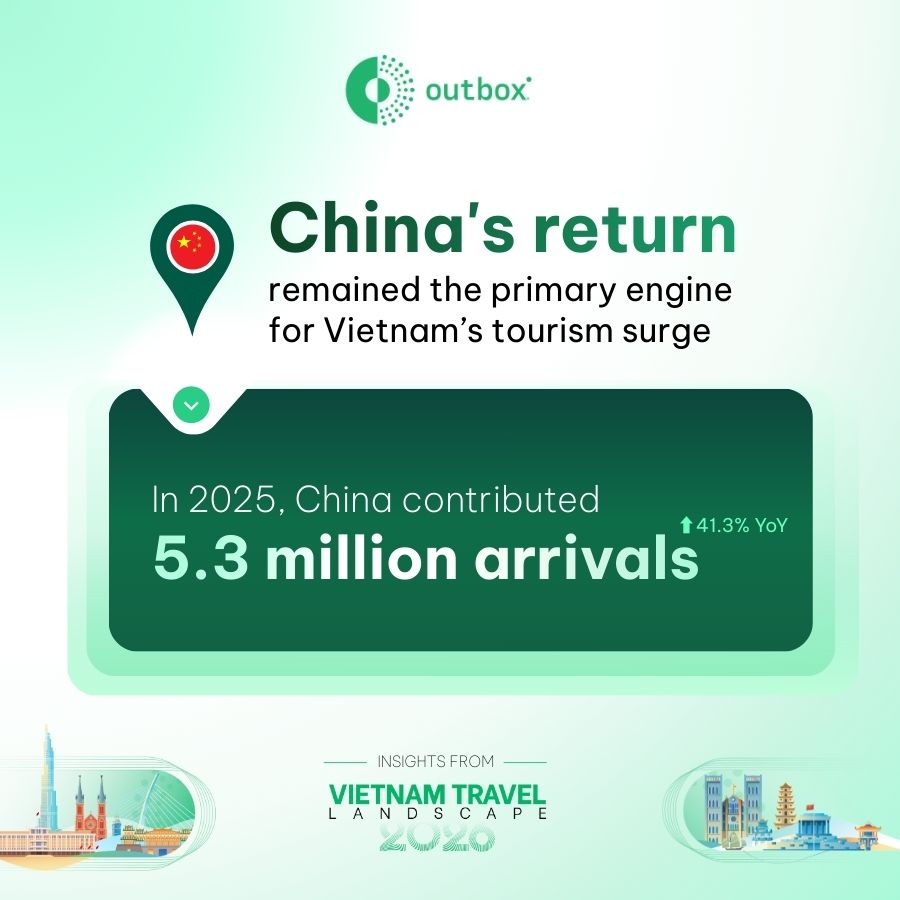
In 2025, Vietnam welcomed 5.3 million visitors from China, representing a 41.3% increase compared with 2024. This surge was instrumental in pushing total international arrivals to 21.2 million, allowing Vietnam to effectively close the pandemic recovery gap.
The scale of this rebound also reshaped regional dynamics. Vietnam received more Chinese visitors than Thailand for the first time in recent years, capturing a larger share of outbound demand from mainland China than its traditional regional competitor.
However, the recovery also revealed how heavily Vietnam’s tourism performance depends on Northeast Asia. China and South Korea together account for a disproportionately large share of international arrivals, meaning the overall performance of the industry is increasingly tied to the travel cycles of just two markets.
This concentration creates a tourism economy that is highly responsive to external demand shocks.
The Illusion of Post-Pandemic Growth
The rapid expansion of Chinese arrivals since 2022 has produced headline growth figures that appear extraordinary. Between 2022 and 2025, arrivals from China grew at a compound annual rate exceeding 200%.
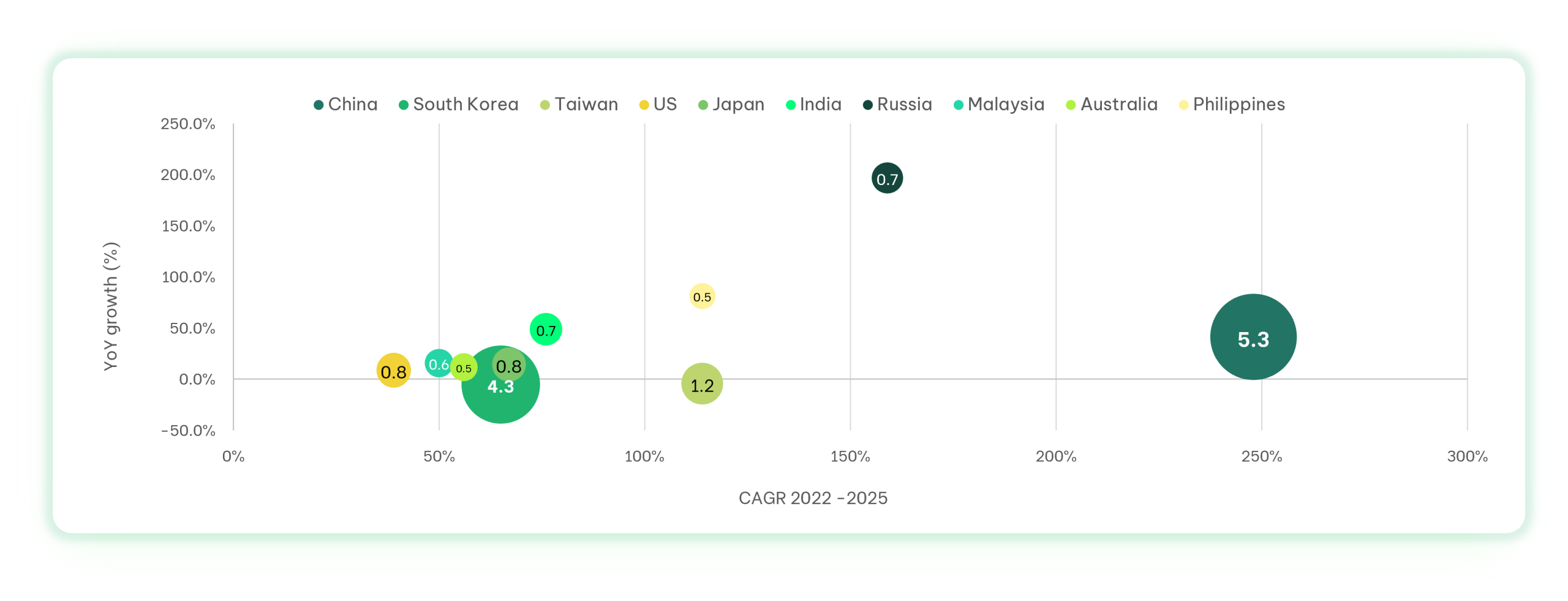
Yet, according to Vietnam Travel Landscape 2026 report, much of this growth reflects a statistical rebound rather than structural expansion. For several years, outbound travel from China remained severely restricted due to pandemic controls. The growth observed in 2024 and 2025 largely represents the restoration of travel patterns that previously existed, rather than the creation of new demand.
As outbound travel stabilizes, this recovery-driven momentum is likely to weaken. Once the remaining recovery gap closes, further growth will depend less on pent-up demand and more on Vietnam’s ability to compete for travelers within a highly competitive regional market.
In practical terms, this means the tourism sector may soon encounter a ceiling where visitor numbers plateau unless new markets begin to play a larger role.
The Chinese Market Is Returning — But It Is Not the Same
Even as arrival numbers recover, the structure of the Chinese outbound market is evolving in ways that fundamentally reshape demand.
Prior to the pandemic, Vietnam’s Chinese market was largely characterized by high-volume group travel, often organized through traditional tour operators. The current recovery shows a noticeable shift toward more independent and digitally mediated travel behavior, particularly among younger travelers.
This transition is clearly reflected in travel patterns during Golden Week 2025, one of the most important travel periods for Chinese outbound tourism. According to industry data, 56% of travelers chose Free Independent Travel (FIT), while 17% opted for private tours, and only 27% participated in traditional group tours. In revenue terms, FIT now accounts for 47.3% of the Chinese outbound travel market, whereas group travel once represented roughly half of total market value prior to the pandemic.
Digital ecosystems are playing a central role in this shift. Travel discovery, trip planning, and bookings are increasingly mediated through online platforms, mobile payment systems, and social media content, which now function as primary channels shaping destination awareness and travel decisions.
This shift changes the competitive landscape for destinations. Instead of competing primarily through tour operator distribution networks, countries must now compete through digital visibility, flexible travel experiences, and more diverse tourism products.
Destinations that fail to adapt to these evolving expectations risk losing relevance even if overall outbound demand continues to grow.
The Fragility of Policy-Driven Demand
Even as China’s outbound market evolves, one characteristic remains unchanged: its sensitivity to policy shifts.
Unlike many Western outbound markets, Chinese travel flows can be strongly influenced by government policy, visa regulations, diplomatic relations, and aviation capacity decisions. This means that demand can expand rapidly under favorable conditions but contract just as quickly if those conditions change.
For destinations heavily reliant on Chinese arrivals, this creates a layer of volatility that lies largely outside the control of tourism operators or destination marketers.
Vietnam’s experience during the pandemic demonstrated how quickly such dependence can translate into vulnerability. The abrupt disappearance of Chinese group travel in 2020 exposed just how much of the regional tourism ecosystem had been built around that single market.
From Demand Recovery to Portfolio Management
As Vietnam’s tourism industry enters its next growth phase, the strategic challenge is gradually shifting from recovery to resilience.
The issue is no longer attracting more visitors in absolute terms. Instead, it is managing the composition of demand.
In 2025, the top five inbound markets accounted for more than half of Vietnam’s international arrivals. This level of concentration means that fluctuations in just one or two major markets can significantly affect national tourism performance.
Reducing that exposure will require expanding the role of emerging markets. India, Australia, and several European countries have shown promising growth potential, supported by improved connectivity and evolving travel demand.
Diversifying the visitor base does not mean replacing China as Vietnam’s largest market. Rather, it means building a broader demand portfolio that allows the industry to absorb shocks without destabilizing overall growth.