
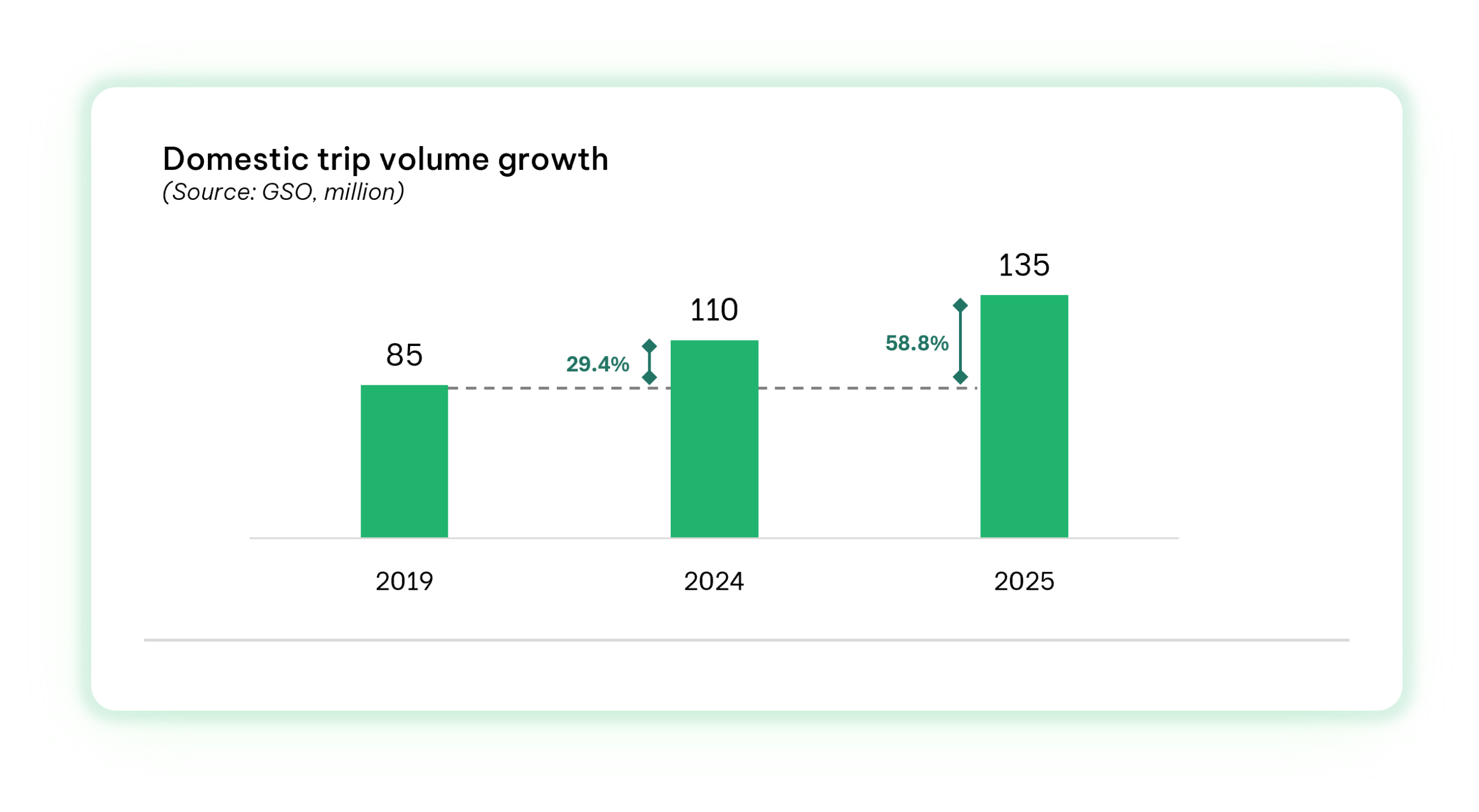
Domestic travel is no longer a supporting act. It is the system’s stabilizer, its testing ground, and increasingly, its most reliable source of demand resilience. The question is no longer whether domestic tourism matters, but whether businesses are treating it with the strategic weight it now demands.
Scale That Can No Longer Be Ignored
More importantly, domestic tourism has maintained its position as a near-equal contributor to total tourism revenue. Based on analysis from Vietnam Travel Landscape 2026 Report, in both 2024 and 2025, it generated an estimated USD 17–20 billion, accounting for roughly 43–51% of total tourism receipts—even as international arrivals surged.
This parity challenges a long-standing industry assumption—that domestic travel is merely a fallback during international downturns. In reality, it has become a foundational pillar of Vietnam’s tourism economy, sustaining cash flow, smoothing seasonality, and reducing exposure to external shocks.
The Real Shift Is Behavioral, Not Just Structural
The structural impact of Vietnam domestic tourism 2025 is not driven by scale alone, but by a fundamental shift in how Vietnamese travelers approach travel.
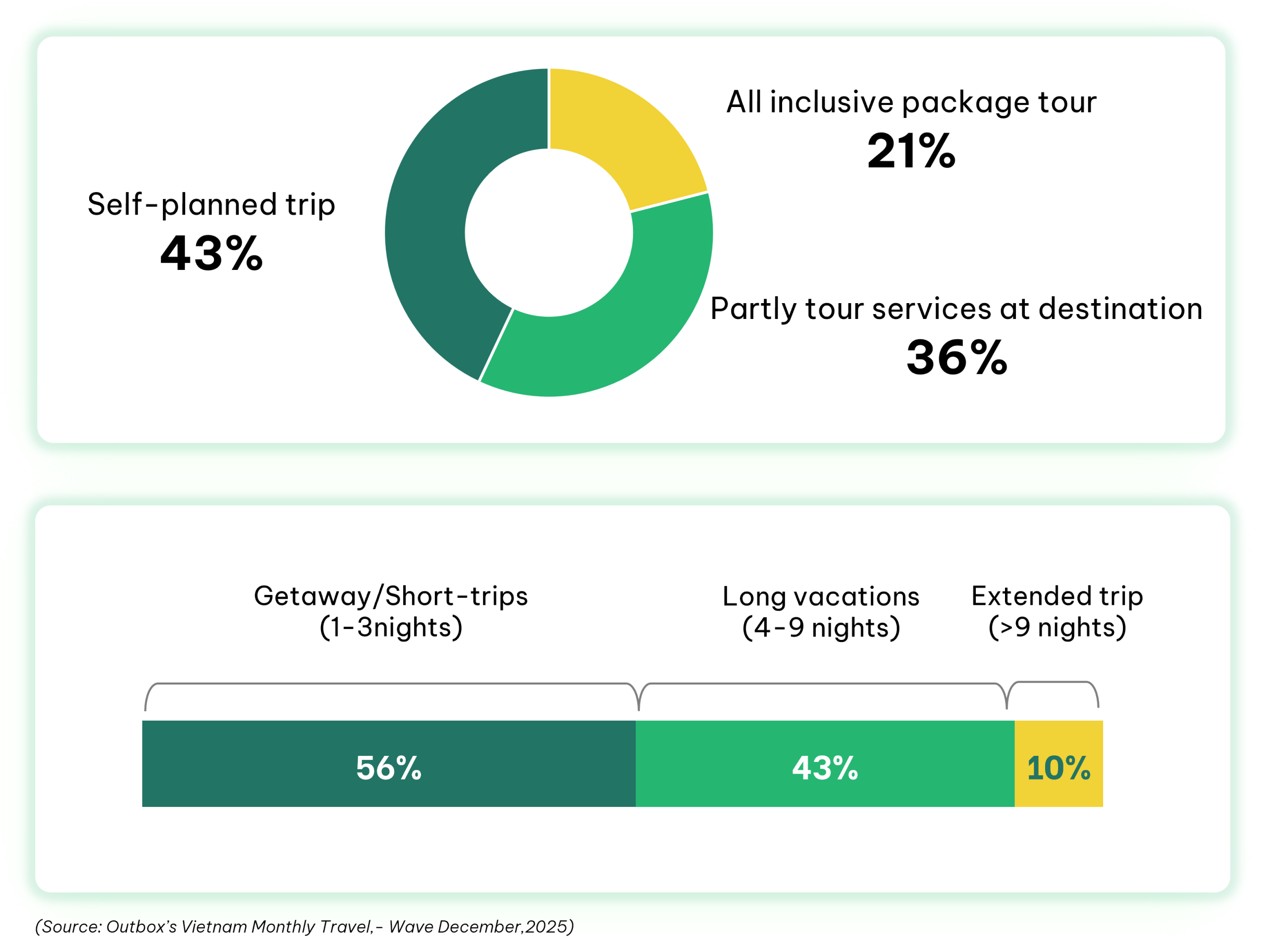
Data from Vietnam Travel Landscape 2026 Report highlights short, high-frequency trips have become the dominant pattern for Vietnam domestic tourism. In 2025, 56% of domestic journeys last just one to three nights. Travel is no longer centered around one long annual holiday. Instead, it is broken into multiple, shorter trips spread across the year. Alongside this, trip planning has become more independent, with 43% of travelers organizing their own itineraries rather than relying on packaged tours.
This behavioral transformation has direct economic consequences.
Historically, Vietnam’s tourism revenue was highly concentrated—peaking during Tet, summer holidays, and international high seasons, while dropping sharply during off-peak periods. This created a “lumpy” demand curve, with businesses oscillating between overcapacity and underutilization.
The rise of short, frequent trips is effectively correcting this imbalance.
Instead of relying on one or two major trips per year, travelers are now distributing their demand across multiple occasions—weekends, mini-breaks, and spontaneous travel moments. As a result, demand is no longer compressed into a few peak periods but spread more evenly throughout the year.
This shift does more than smooth seasonality— it improves how revenue is generated and how operations are managed:
- It creates a more consistent and predictable flow of demand
- It reduces pressure on peak periods while lifting off-peak performance
- It enables better workforce planning and operational stability
- It supports more consistent service quality across the year
In this sense, evolving Vietnamese travel behavior is transforming the industry’s revenue model. Instead of amplifying seasonality, domestic tourism is absorbing and redistributing demand, turning volatility into stability.
Implications for Business
If domestic tourism is now structurally embedded in Vietnam’s travel economy, then the role of businesses must also evolve—from passive service providers to active shapers of demand.
The most immediate implication is that domestic travel should be treated as a strategic testing ground for innovation, not a secondary revenue stream.
Unlike international markets, where demand is slower to react and more exposed to external risks, the domestic segment is fast-moving, iterative, and highly responsive. This makes it the most effective environment to experiment, refine, and scale.
Businesses should be using this market deliberately across three critical dimensions:
1 – Experience Innovation and Product Design
Domestic travelers, particularly those engaging in short getaways, are highly sensitive to convenience, novelty, and relevance. This creates an ideal setting to test new formats—modular itineraries, themed stays, wellness packages, or hyper-local experiences—before scaling them to international audiences.
2 – Pricing Strategy and Value Engineering
With most domestic trips operating within defined budget thresholds, the market provides clear signals on price elasticity. Businesses can use this to refine pricing models, bundle services more effectively, and identify where travelers are willing to trade up. This is critical for moving beyond price-led competition toward value-led positioning.
3 – Operational Excellence and Service Consistency
High-frequency domestic demand offers something international markets cannot: repetition. This creates the conditions needed to strengthen service delivery, train staff, andoptimize operations continuously. By the time international demand scales, service standards are no longer theoretical—they are already embedded.
Taken together, these functions position domestic tourism as a live operating system for capability building.
As the market evolves, the winners will be those who treat domestic tourism not as a fallback, but as the starting point for smarter growth.