Why Being Well-Known Is No Longer a Competitive Advantage
Vietnam does not struggle with visibility.
Within the context of the Vietnam destination brand 2026, the country is widely known, easy to access, and broadly liked across key Asian markets. It fits comfortably into travelers’ mental maps of the region – a destination that is familiar enough to trust, and attractive enough to consider. But that very familiarity raises a more difficult question: what makes Vietnam the preferred choice, rather than just an available one?
This distinction matters more in 2026 than it did in earlier phases of tourism growth. As destinations converge in visibility and accessibility, the competitive edge shifts away from recognition and toward differentiation – the ability to offer something that is not only appealing, but clearly distinct and worth prioritizing.
A Brand Strong in Reach, Weaker in Definition
According to Vietnam Travel Landscape 2026 Report, Vietnam’s current brand profile reflects a system that has been highly effective in expanding reach, but less developed in consolidating meaning.
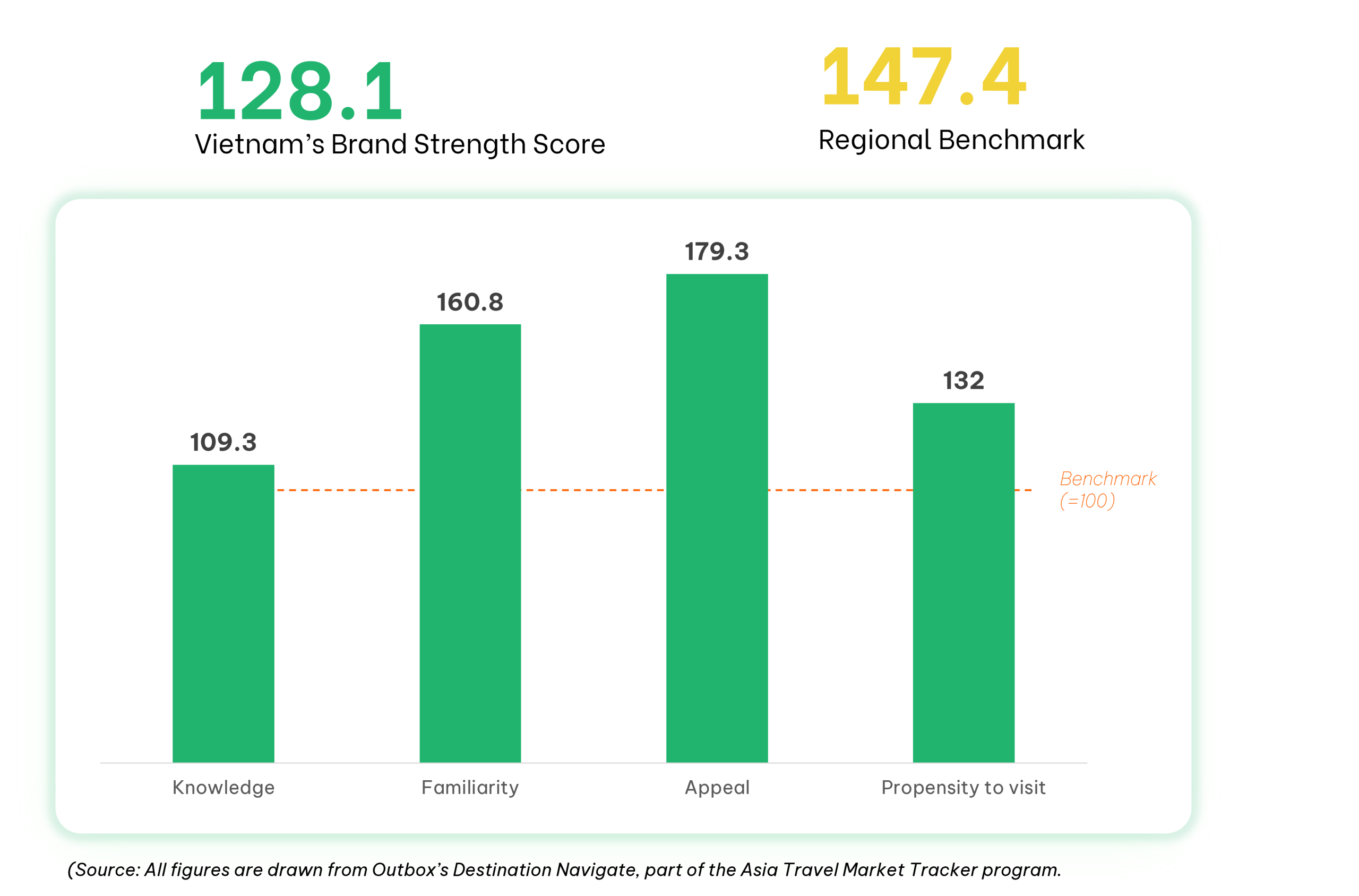
Outbox’s Destination Brand Strength Score (128.1) confirms that Vietnam holds a strong overall position. This performance is driven primarily by:
- Familiarity (160.8), indicating extensive market penetration
- Appeal (179.3), reflecting broadly positive perceptions
These are important strengths. They reduce friction in destination choice and enable Vietnam to attract a wide range of travelers, particularly in short-haul and regional markets.
However, the relative position of Knowledge (109.3) introduces a different dimension. It suggests that while Vietnam is widely recognized, the clarity of what it represents is less fully formed. Perceptions tend to cluster around broad attributes—affordability, natural scenery, cultural richness—rather than sharply differentiated experiences.
In practical terms, this creates a brand that is:
- easy to recall
- easy to consider
- but less precise in what it stands for
The result is a destination that is easy to include in consideration, but harder to justify as a deliberate, prioritized choice.
The Structural Risk of Broad-Based Appeal
Broad appeal is often treated as an advantage, particularly in high-growth phases. It allows destinations to attract diverse segments without needing highly specialized positioning.
However, at a more mature stage, broad appeal can introduce strategic ambiguity.
When a destination is associated with general attributes – such as affordability – it becomes part of a shared regional narrative rather than a clearly differentiated one. These attributes are valuable, but they are not exclusive.
This creates a condition of comparative substitutability, where Vietnam is competing within a cluster of destinations that offer similar perceived value. In such an environment, decision-making is influenced more heavily by external variables:
- pricing differentials
- flight availability
- travel convenience
- short-term promotional activity
Over time, this reduces the role of brand in shaping demand. The destination remains competitive, but its advantage becomes situational rather than structural.
The Advocacy Gap and Its Implications for Growth
The consequences of this positioning challenge become most visible when examining visitor advocacy. According to data from Outbox’s Destination Navigate, Vietnam’s Net Promoter Score (NPS) stands at 24.2, significantly lower than regional competitors such as Thailand (53.4) and Singapore (59.2). This gap is not merely a reflection of satisfaction levels, but an indicator of how effectively visitor experiences translate into recommendation behavior.
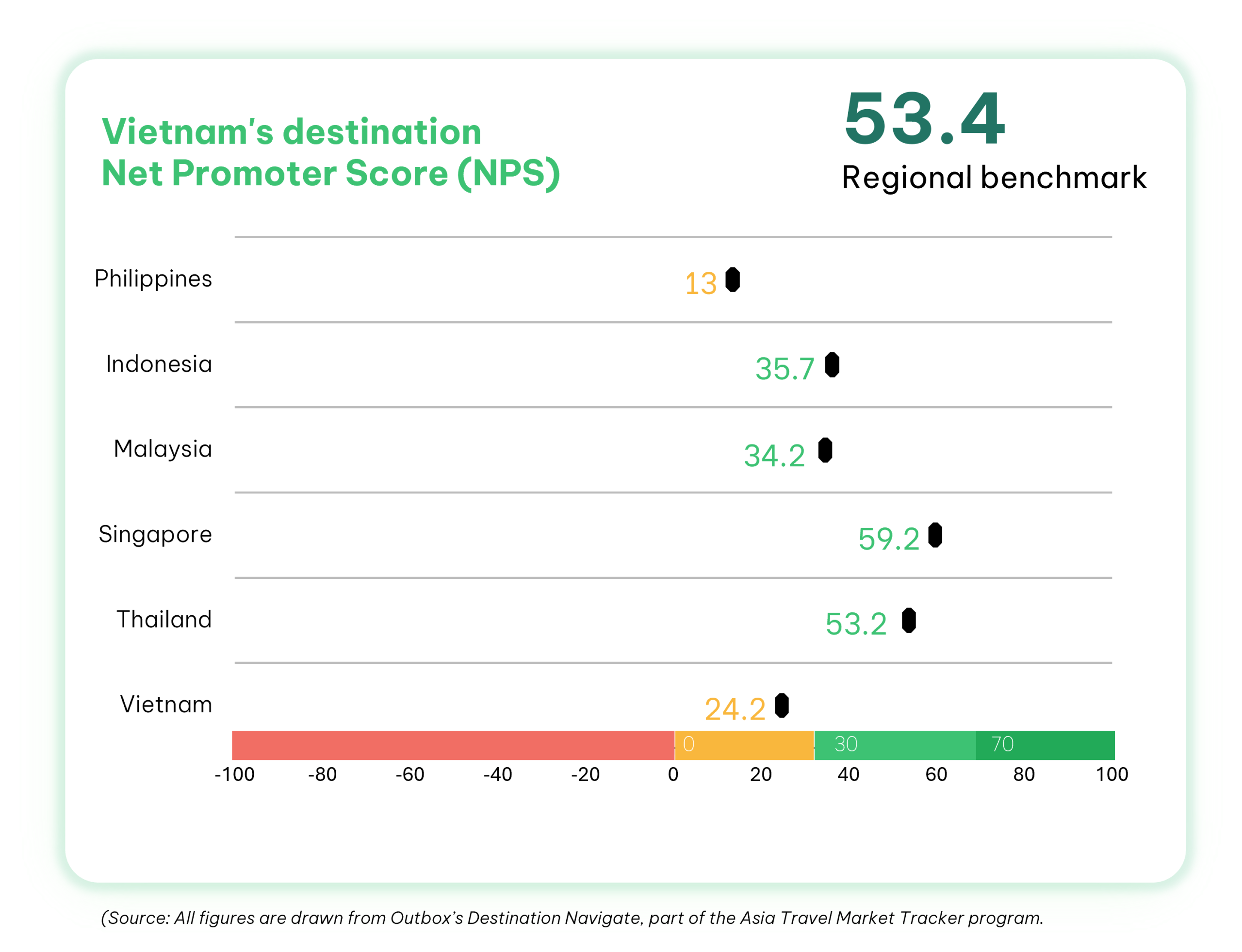
High-performing destinations benefit from a compounding growth dynamic in which satisfied visitors actively promote the destination, generating organic demand through credible, peer-driven influence. This form of advocacy reduces reliance on paid marketing and strengthens long-term brand equity. The Vietnam destination brand 2026 highlights a key gap in this dynamic. Vietnam’s relatively modest NPS suggests that while visitors generally have positive experiences, those experiences are not consistently distinctive or memorable enough to drive strong word-of-mouth.
As a result, Vietnam remains more dependent on externally driven demand generation and growth must be “re-earned” each year—through:
- sustained marketing investment
- competitive pricing strategies
- tactical promotions to maintain visibility
This creates a less efficient growth model, where demand is continuously stimulated rather than organically amplified.
Differentiation as a Lever for Value Creation
At this stage, differentiation should not be viewed solely as a branding exercise, but as a core driver of economic performance. A clearly differentiated destination does more than attract visitors—it shapes how they engage, how long they stay, and how much they spend.
When a destination is clearly differentiated:
- it creates a stronger reason to choose, not just a reason to consider
- it anchors expectations around specific, value-rich experiences
- it reduces reliance on price as the primary decision factor
This has direct implications for tourism yield per visitor.
Travelers who select a destination for its distinctiveness are more likely to:
- engage in curated or experience-driven activities
- extend their stay to explore multiple aspects of the destination
- allocate spending toward experiences that align with perceived uniqueness
Conversely, when differentiation is weak, visitor behavior remains relatively generic. Even with strong arrival numbers, engagement lacks depth, and spending patterns remain concentrated around basic services. This dynamic helps explain why growth in visitor volume does not always translate into proportional growth in economic value—a pattern that continues to shape Vietnam’s tourism performance.