

For decades, market research followed a predictable rhythm. Annual surveys and quarterly reports provided a steady, if slow, understanding of the market. While these methods offered incredible depth, they lacked the agility to capture the “now.” Conversely, the rise of Big Data promised real-time insights, but often delivered a “black box” of numbers without the human context needed to explain the “why.”
If you rely solely on traditional surveys, you risk missing the sudden market shifts triggered by social media or global events. If you rely solely on digital footprints (like OTA bookings or social listening), you see the action but fail to understand the motivation.
The Hybrid Data Strategy was born from the necessity to bridge this gap. It is a step-change in both the speed of detection and the depth of insight, ensuring that travel brands are not just reacting to the market, but anticipating it.
Defining the Hybrid Data Strategy: The Integration of Depth and Speed
At its core, a Hybrid Data Strategy is a comprehensive data approach that integrates traditional primary research methodologies with continuous market intelligence systems. This is not merely the simultaneous use of two different tools; it is a functional fusion where each data stream compensates for the inherent weaknesses of the other.
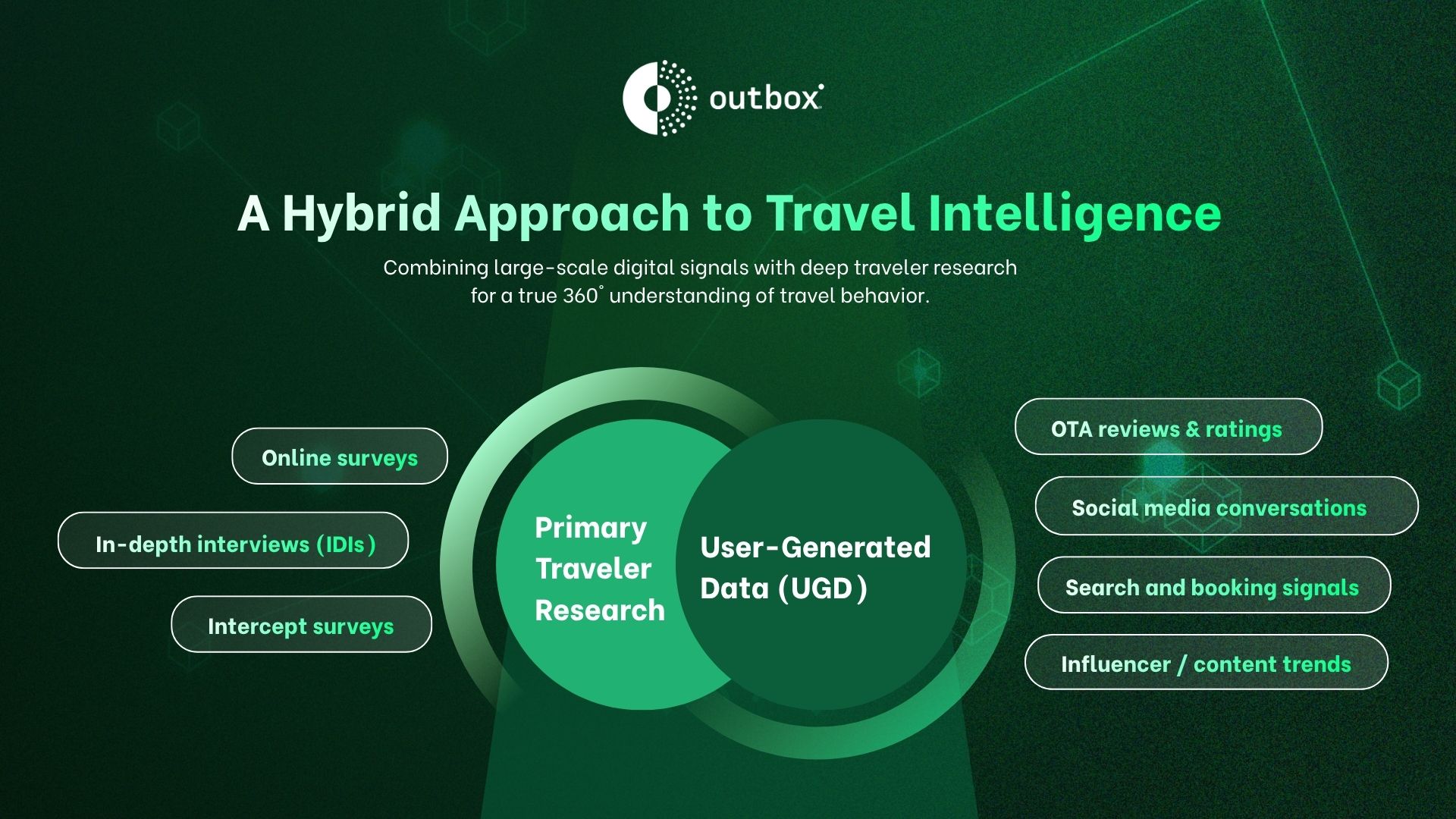
In this framework, data is categorized into two primary engines:
- Primary Research: Structured, intentional data collection designed to uncover the “why” behind traveler behavior.
- User-Generated Data: Continuous, large-scale data derived from real traveler interactions across digital platforms.
By aligning these two engines, a Hybrid Data Strategy provides a 360-degree perspective. It allows organizations to see not only the “breadbox” trails of digital transactions but also the psychological drivers that lead to those transactions. This approach ensures that market intelligence is both deep enough to inform long-term strategy and fast enough to guide weekly tactical adjustments.
Pillar I: Primary Traveler Research – The Depth of the Human ``Why”
The first pillar of a robust Hybrid Data Strategy is Primary Traveler Research. This remains the gold standard for understanding the deep-seated motivations, anxieties, and aspirations of the modern traveler. Direct engagement through structured, scientifically rigorous methodologies allows for the exploration of nuances that digital footprints simply cannot capture.
Understanding Behavioral Nuances
Direct engagement with travelers helps surface the subtle drivers behind decisions—factors that are often too complex or emotional to be expressed through clicks, ratings, or short-form reviews.
For example, two travelers may both choose a domestic destination over an international one. Digital data would register this as a trend toward domestic travel. But primary research reveals why:
- One segment may be driven by financial caution amid economic uncertainty
- Another may prioritize convenience due to limited time off
- A third may be influenced by a growing preference for “low-stress” travel experiences
These distinctions matter. Without them, strategies risk being overly generalized and less effective.
Revealing Hidden Friction Points
Not all barriers to travel are visible in behavior. In many cases, what travelers don’t do is just as important as what they do.
Primary research can uncover:
- Concerns about visa complexity or travel regulations
- Perceived safety risks that are not reflected in actual conditions
- Emotional hesitation around unfamiliar destinations
- Mismatches between expectations and perceived value
For instance, a destination may see strong awareness but low conversion. UGD might show limited bookings, but only primary research can reveal that travelers perceive the destination as “not worth the effort” due to unclear value propositions or lack of accessible information.
Mapping the Decision-Making Journey
Travel decisions are rarely linear. They are shaped by multiple touchpoints—social influence, past experiences, financial considerations, and personal aspirations.
Primary research helps map this journey in detail:
- What triggers initial inspiration?
- What factors accelerate or delay decision-making?
- Where do travelers drop off in the booking process?
This allows businesses to identify critical intervention points. For example, if travelers are inspired but fail to convert due to price uncertainty, targeted messaging or pricing transparency can be introduced at the right stage.
Contextualizing Macro Trends
Many trends appear obvious at a surface level—wellness travel, sustainability, cultural immersion. But their meaning varies significantly across segments.
Primary research adds the necessary context:
- “Sustainability” may mean eco-conscious accommodations for one group, but simply less crowded destinations for another
- “Luxury” may shift from opulence to privacy and exclusivity
- “Authenticity” may reflect a desire for local connection rather than curated experiences
By grounding trends in real traveler perspectives, businesses can avoid misinterpretation and design strategies that truly resonate.
Pillar II: User-Generated Data (UGD) – The Pulse of Real-Time Intelligence
If primary research reveals the why, user-generated data reveals the what—at scale, in real time, and across the entire travel ecosystem.
Every review, rating, comment, and shared experience contributes to a constantly evolving dataset that reflects how travelers interact with destinations, services, and brands in the real world.
Outbox harnesses this data not just for volume, but for pattern recognition and continuous monitoring.
Detecting Emerging Signals Before They Peak
One of the most powerful aspects of UGD is its ability to surface early signals—small shifts that may not yet be visible in structured datasets.
For example:
- A gradual increase in mentions of a previously overlooked destination
- Rising discussions around specific experiences, such as night markets or eco-tours
- Subtle changes in traveler expectations, such as demand for contactless services or flexible bookings
These signals often appear weeks or months before they become mainstream trends. By identifying them early, businesses can act ahead of competitors.
Understanding Experience in Real Conditions
Unlike survey responses, which are often reflective, UGD captures experiences as they happen—or immediately after. This makes it particularly valuable for understanding operational realities.
For instance:
- A hotel may position itself as premium, but reviews consistently highlight slow service or inconsistent cleanliness
- A destination may promote cultural richness, but travelers frequently mention overcrowding or lack of accessibility
- A tour product may receive high ratings overall, but recurring complaints point to specific pain points
These insights allow for precise, experience-level improvements rather than broad assumptions.
Tracking Sentiment and Perception Over Time
Traveler perception is not static—it evolves based on experiences, external events, and shifting expectations.
UGD enables continuous sentiment tracking:
- Are reviews becoming more positive or negative over time?
- Are certain aspects (service, value, location) driving sentiment changes?
- How does perception compare across competitors or destinations?
For example, a sudden dip in sentiment might initially appear alarming. But deeper analysis may reveal that it is tied to a temporary issue—such as peak-season overcrowding—rather than a structural problem.
Differentiating Noise from Meaningful Patterns
One of the challenges with UGD is its volume and variability. Not every data point is equally valuable.
Outbox’s approach focuses on identifying patterns, not isolated opinions:
- Recurring themes across large datasets
- Consistent feedback across multiple platforms
- Correlations between sentiment and specific attributes
This ensures that insights are grounded in reliable signals rather than anecdotal evidence.
The Outbox Approach: Connecting Data for Better Decisions
Outbox’s approach focuses on bringing different data sources into one aligned system, where primary research and user-generated data are not viewed separately but interpreted together. This creates a consistent, end-to-end understanding of travelers, removing contradictions and giving teams a shared foundation for decision-making.
Rather than relying on one-off studies or disconnected reports, the model is built for continuity. Ongoing market signals are layered with deeper research to show not just what is changing, but how those changes evolve over time and what they actually mean. This allows businesses to stay responsive to real-time shifts while still grounding decisions in a solid strategic context.
In practice, this means decisions are more focused, more timely, and more aligned across functions. Instead of asking “what does the data say?”, the question becomes “what should we do next?”. If your current approach still relies on disconnected data or periodic snapshots, there’s a clear opportunity to rethink it. Work with Outbox to build a more connected, insight-driven foundation for your strategy.