
The year 2025 marked a definitive turning point for Vietnam’s tourism industry, signaling the formal conclusion of the post-pandemic recovery phase and the beginning of a complex transition toward long-term resilience. While headline figures suggest a sector in full bloom, a deeper Vietnam tourism industry analysis reveals structural constraints that must be addressed to ensure sustainable competitiveness in 2026 and beyond.
2025: A Year of Record-Breaking Normalization
Vietnam’s tourism sector entered 2025 with unprecedented momentum, successfully eclipsing pre-pandemic performance benchmarks. International arrivals reached an estimated 21.1 to 21.5 million, representing an approximately 17.5% increase over 2019 volumes. This surge translated into a total tourism revenue of approximately USD 39 billion—a 27% increase compared to 2019—marking the first time the industry’s economic contribution surpassed the 1 quadrillion VND milestone.
However, these figures also highlight a “normalization” of growth. The rapid, recovery-driven spikes of 2023 and 2024 have begun to plateau into a more stable, yet constrained, expansion. While Vietnam was ranked by UN Tourism among the world’s fastest-growing markets in 2025, it simultaneously found itself anchored in third place for Southeast Asian arrivals. This gap suggests that while Vietnam is moving fast, it is still playing catch-up to the brand depth and infrastructure of its regional competitors like Thailand and Malaysia.
Consequently, 2026 represents a pivot point. The industry can no longer rely on the ‘low-hanging fruit’ of returning travelers and must instead focus on deepening its competitive moat through premiumization and service consistency.
Key Trends Shaping the Vietnam Tourism Outlook 2026
As the industry looks toward 2026, Vietnam Travel Landscape 2026 Report highlights five major structural trends are emerging as the primary drivers of the next growth phase:
- Addressing Persistent Market Concentration
Despite persistent efforts to diversify, Vietnam’s inbound tourism remains heavily anchored in a few key geographies. The top three source markets—dominated by China and South Korea—account for nearly 50% of all international arrivals. When expanded to the top five markets, this concentration reaches 55%, exposing the sector to significant systemic risks from geopolitical shifts or regional economic volatility.
Moving toward 2026, the strategy must shift toward “Managed Resilience”. While secondary markets such as India, Russia, and the Philippines have shown promising rises in their share of arrivals, none currently exceed a 3% share individually. The report notes that whether secondary markets like India, Australia, the Middle East, and long-haul Europe will grow faster than core markets remains an intriguing question for 2026. To build a demand base that is structurally more stable and less shock-sensitive, Vietnam must now actively cultivate growth from these non-core markets.
- The Normalization of the China Rebound
The Chinese market was a primary engine of the 2025 surge, contributing 5.3 million arrivals—a 41.3% year-over-year increase. Notably, Vietnam welcomed more Chinese visitors than Thailand in 2025, which saw 4.5 million arrivals. This return of volume is a significant achievement, but it comes with a fundamental shift in traveler behavior that requires a total recalibration of Vietnam’s destination offers.
The nature of Chinese demand has moved away from traditional mass group tours toward younger, digital-savvy demographics, particularly Generation Z. These travelers are increasingly opting for Free Independent Travel (FIT), digital bookings, and immersive experiences. During Golden Week in 2025, FIT accounted for 47.3% of market revenue, while traditional group travel, which once made up half the market, has seen a steady decline. For 2026, success in this market will depend on adapting to these behavioral changes rather than relying on the group-tour models of the past.
- Domestic Demand as a Strategic Economic Anchor
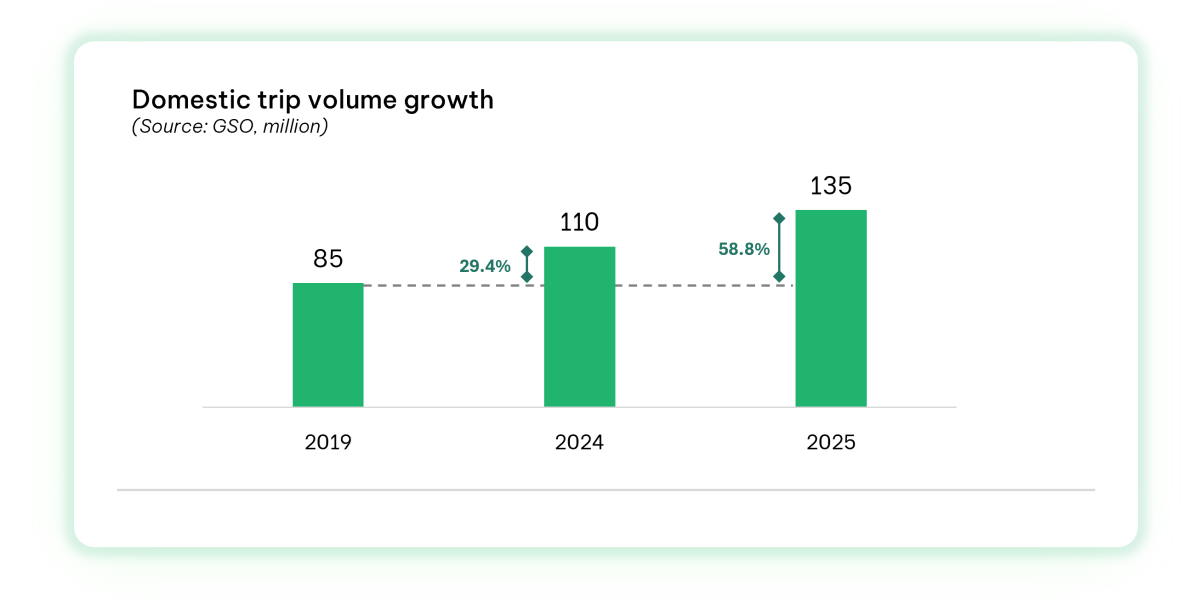
One of the most vital Vietnam travel trends 2026 is the maturation of the domestic market into a reliable economic stabilizer. In 2025, domestic trips soared to 135.5 million—a 58.8% increase over 2019 levels. Generating between USD 17–20 billion, domestic travel now contributes nearly half of total tourism receipts, providing year-round stability and ensuring the survival of service providers during international low seasons.
In the 2026 landscape, the domestic market is no longer viewed as a foundational stabilizer of Vietnam’s travel economy. Because domestic travelers provide predictable, year-round demand, the market serves as an ideal “testing ground” for service enhancements and experience design before they are scaled for international visitors. This internal strength allows the industry to absorb systemic shocks and predict broader demand shifts with remarkable accuracy.
- Closing the Brand Competitiveness Gap
A major headwind for Vietnam is the disparity between its high brand familiarity and its low levels of traveler advocacy. The country’s Brand Strength Score (128.1) remains significantly below the regional average of 147.4. Most critically, Vietnam’s destination Net Promoter Score (NPS) of 24.2 lags far behind regional leaders like Thailand and Singapore, which boast scores above 53.
This “advocacy gap” suggests that while travelers are attracted to Vietnam’s affordability and beautiful landscapes, the actual visitor experience often fails to convert them into enthusiastic promoters. High familiarity combined with low “deep knowledge” means the brand is visible but lacks the depth required to foster long-term loyalty. By 2026, the focus must shift from policy-driven growth (such as visa changes) to brand-led demand, improving service consistency, safety, and ease of travel to move beyond the “transactional zone” of affordability.
- Value Density Pressure
A critical challenge for the 2026 landscape is the disconnect between visitor volume and economic yield. While international arrivals have surpassed record levels, revenue growth has largely tracked volume rather than outperforming it, leading to a decrease in “value density”. Vietnam remains a high-volume, low-yield destination, with limited evidence of premiumization in visitor spending.
Without an increase in yield, the economic contribution of the sector risks stagnation despite rising numbers. To address this, the 2026 strategy must intentionally focus on “yield over quantity,” developing mid-premium products and encouraging longer stays to improve the economic value generated by each visitor.
Structural Outlook for 2026: The Resilience Phase
According to the Vietnam Travel Landscape Report 2026 Report, the roadmap for 2026 is centered on a shift from recovery-led growth to resilience-led development. The priority is no longer just maximizing arrivals, but actively managing growth through a balanced, value-driven approach. This involves four strategic pillars:
- Active Diversification: Reducing over-reliance on Northeast Asian markets to build a demand structure that is less sensitive to regional shocks.
- Meaningful Differentiation: Moving from general brand appeal to signature experiences that improve the Net Promoter Score and convert visitors into advocates.
- Value-Led Growth: Prioritizing yield and longer stays over simple volume to maximize the economic impact per visitor.
- Leveraging the Domestic Foundation: Using the resilient domestic market as a platform for service reform and innovation.
By addressing these core areas, Vietnam can transition from being a fast-growing destination to a sustainably competitive one, ensuring that its tourism future is defined by resilience and quality.