

Regional Overview: Growth Stabilizes Below Pre-Pandemic Levels
Southeast Asia’s tourism sector reached a critical inflection point in 2025. With approximately 139.4 million international arrivals, the region has largely completed its post-pandemic recovery phase and is now entering a period defined by structural constraints rather than rebound dynamics.
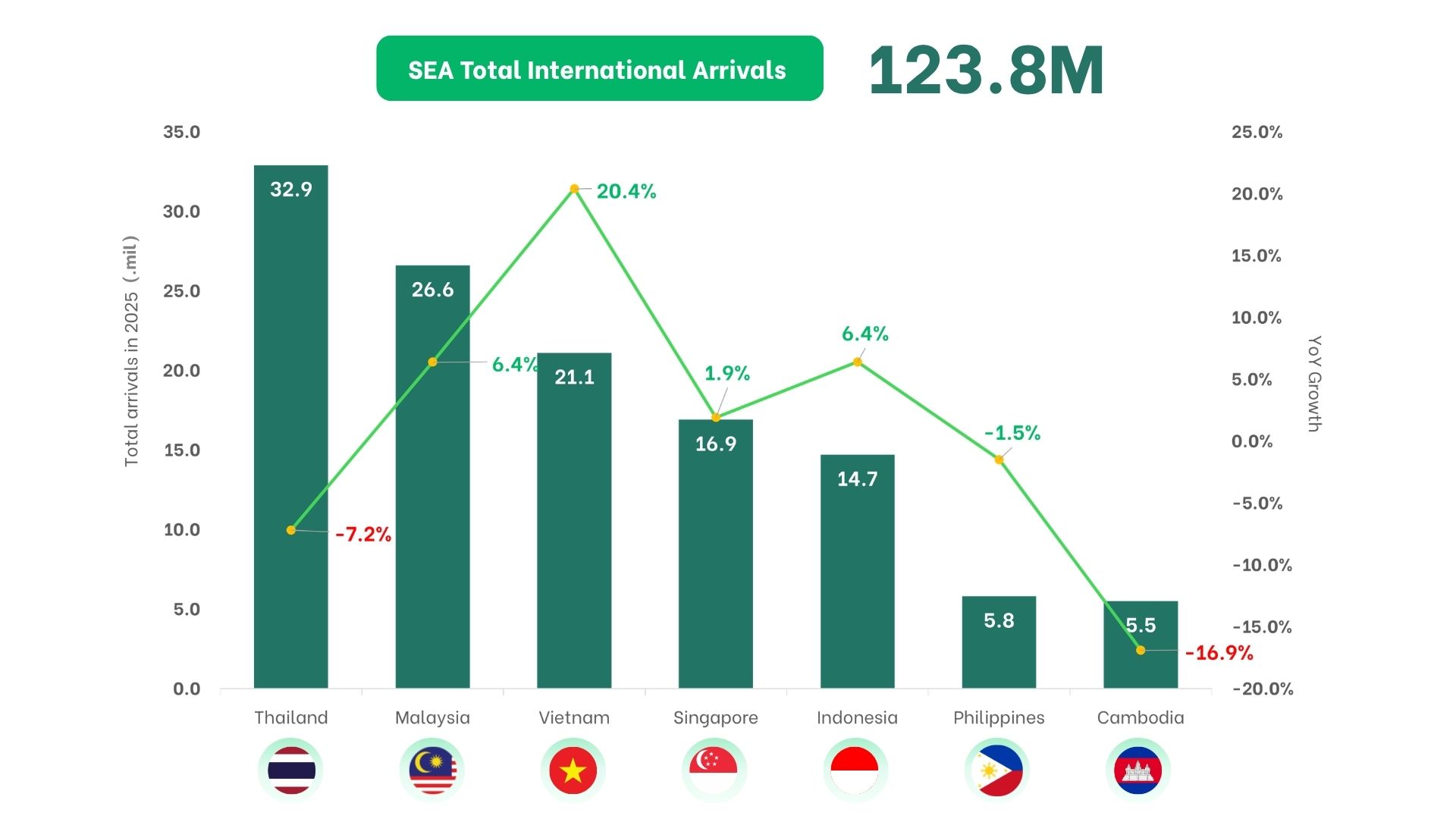
Across the seven key destinations, total arrivals reached 123.9 million, reflecting modest growth of 2.1% year-on-year, but still 7.6% below 2019 levels. This gap highlights a fundamental shift: while demand has returned, the drivers of growth have changed. The absence of a full Chinese outbound recovery, combined with evolving traveler behavior and increased regional competition, has created a more complex and less predictable operating environment.
Rather than a uniform recovery story, 2025 reveals a fragmented landscape where each destination is navigating different structural realities.
Thailand: Market Leader Under Pressure
Thailand remained Southeast Asia’s most visited destination, welcoming 32.97 million international tourists in 2025. Despite retaining its leadership position, the country recorded a 7.2% decline compared to 2024, highlighting the fragility of its recovery.
The downturn is closely linked to shifts in its key source markets. Malaysia continued to be the largest contributor, but arrivals declined by nearly 9%. More significantly, China—historically Thailand’s most important market—fell by over 33%, reflecting the uneven return of Chinese outbound travel. This decline has had a disproportionate impact, exposing Thailand’s reliance on a few high-volume markets.
At the same time, emerging markets are beginning to play a more important role. India, in particular, recorded strong growth of nearly 17%, signaling its rising importance in Thailand’s tourism strategy. While this diversification is encouraging, it has not yet been sufficient to offset losses from traditional markets. Thailand’s performance in 2025 ultimately reflects a broader challenge: maintaining volume leadership while adapting to a fundamentally changed demand landscape.
Malaysia: Resilient Growth Anchored in Regional Demand
Malaysia welcomed 26.6 million international visitors in 2025, growing 6.4% year-on-year and slightly surpassing its 2019 level. Unlike more volatile markets in the region, Malaysia’s performance is underpinned by a structurally resilient demand base driven largely by intra-regional travel.
A significant share of visitors comes from neighbouring markets, particularly Singapore, Indonesia, and Thailand, supported by high-frequency, short-haul travel and seamless cross-border connectivity. This regional concentration provides Malaysia with a more stable and predictable source of demand, reducing its reliance on the slower recovery of long-haul markets such as China.
Tourism receipts reinforce this dynamic. Inbound tourism revenue rose sharply in 2025, outpacing arrival growth and generating a substantial travel surplus. This indicates that Malaysia is not only attracting visitors consistently but also converting that demand into economic value. The combination of steady regional flows and improving revenue capture suggests a tourism model that is both resilient and commercially effective, rather than simply volume-driven.
Vietnam: Rapid Growth, Structural Imbalance
Vietnam recorded the strongest growth in Southeast Asia in 2025, with international arrivals increasing by 20.4% to 21.17 million. The country has now exceeded its 2019 performance by 17.5%, marking a significant milestone in its recovery.
According to analysis from The Outbox Company’s Vietnam Travel Landscape 2026, while these figures position Vietnam as a standout performer, they also reveal deeper structural challenges. The surge in arrivals has been driven largely by the return of Northeast Asian markets and competitive pricing. However, tourism revenue has not increased at the same pace, indicating that higher visitor volumes are not translating into proportional economic gains.
This imbalance points to a “high-volume, low-yield” growth model. Vietnam has successfully reactivated demand but has yet to build the brand strength and product differentiation required to command higher spending per visitor. As competition intensifies across the region, this lack of pricing power may limit long-term value creation.
Vietnam’s next phase of development will depend on its ability to move beyond volume-driven growth and strengthen its positioning in higher-value segments.
Singapore: A Deliberate Shift Toward High-Value Tourism
Singapore provides one of the clearest examples in Southeast Asia of a deliberate shift from volume-driven recovery to value-driven growth. In 2025, the country welcomed 16.9 million international visitors, representing a modest increase of around 2.3% year-on-year and still below its 2019 peak of over 19 million arrivals.
At first glance, this relatively measured growth may appear to lag behind faster-expanding destinations such as Vietnam. However, tourism receipts suggest a different trajectory. Singapore generated S$23.9 billion in tourism receipts in the first nine months of 2025, marking a record for that period and a 6.5% increase year-on-year. The stronger momentum in revenue relative to arrivals points to a gradual improvement in visitor spending, indicating that recovery is being driven not only by volume, but increasingly by value.
This pattern reflects the characteristics of Singapore’s tourism model, where growth is supported by high-value segments such as business travel, premium leisure, and globally significant events. Rather than relying solely on increasing visitor numbers, the country’s tourism ecosystem is structured to capture greater economic contribution per visitor through integrated offerings spanning hospitality, retail, dining, and entertainment.
Aligned with its long-term Tourism 2040 ambition, Singapore’s trajectory suggests a continued emphasis on sustainable, high-quality growth. In this context, 2025 does not represent a dramatic shift, but rather a continuation of a longer-term direction in which value creation plays an increasingly central role alongside visitor volume.
Indonesia: Gradual but Incomplete Recovery
Indonesia continued its steady recovery in 2025, welcoming 14.76 million visitors, up 6.4% from the previous year. However, the country remains 8.4% below its 2019 level, indicating that its recovery is still incomplete.
Indonesia’s performance reflects structural challenges related to geography and infrastructure. While key destinations such as Bali have rebounded strongly, broader national recovery has been slower due to uneven connectivity and limited development in secondary destinations. Nevertheless, the country’s improving brand perception suggests that it has a solid foundation for future growth if these constraints can be addressed.
Philippines: Persistent Barriers to Recovery
The Philippines’ tourism recovery remains muted in 2025, with arrivals declining slightly and still nearly 30% below 2019 levels. This makes it one of the weakest performers in the region, not due to a lack of global demand, but due to ongoing frictions that limit its ability to fully capture it.
Key constraints continue to center around air connectivity, cost competitiveness, and ease of movement. Compared to neighboring destinations, the Philippines offers fewer direct long-haul routes, while relatively high travel costs and fragmented domestic transport reduce overall accessibility. Its archipelagic geography adds another layer of complexity, making travel itineraries less seamless and, in many cases, less attractive than mainland Southeast Asia alternatives. As competition intensifies, these barriers are becoming more pronounced, directly impacting the country’s ability to convert interest into actual arrivals.
Cambodia: Decline Signals Fragility in Demand Base
Cambodia recorded a sharp 16.9% decline in international arrivals in 2025, placing it among the region’s weakest performers. The scale of the drop suggests more than short-term fluctuation, pointing instead to underlying fragility in how demand is built and sustained.
Tourism to Cambodia remains concentrated in a limited number of source markets and experiences, leaving it more exposed when demand shifts. At the same time, external factors are starting to play a more visible role. Periodic tensions along the Cambodia–Thailand border, while relatively contained, can still shape traveler perception—especially among long-haul visitors who tend to be more cautious when evaluating regional stability. In a highly competitive environment, even subtle shifts in sentiment can have an outsized impact on destinations that lack strong brand insulation or diversified demand streams.
Beyond Arrivals: The Growing Importance of Brand Strength
The uneven recovery across Southeast Asia in 2025 suggests that arrivals alone are no longer sufficient to explain performance. As growth stabilizes, the real differentiator is a destination’s ability to convert demand into value—and this is increasingly shaped by brand strength.
Destination Brand Strength Score™ 2025
| Singapore | 156.1 |
| Thailand | 151.3 |
| Malaysia | 136.2 |
| Indonesia | 132.6 |
| Vietnam | 128.1 |
| Cambodia | 120.2 |
| Philippines | 119 |
The Destination Brand Strength Score™, an index developed by Outbox, provides a useful lens to understand this shift. In 2025, Singapore (156.1) and Thailand (151.3) continue to lead the region, reflecting strong global positioning and sustained appeal. However, their outcomes diverge. Singapore translates brand equity into higher visitor spending and premium demand, while Thailand remains more exposed to fluctuations in volume, particularly from key source markets.
In contrast, Vietnam (128.1) highlights the limitations of growth without corresponding brand power. Despite leading the region in arrival growth, its positioning constrains pricing power, reinforcing a high-volume, lower-yield model. A similar gap can be observed in Cambodia (120.2), where improvements in brand strength have yet to translate into stronger demand.
As the region moves beyond recovery, this distinction becomes critical. The competitive advantage will increasingly lie with destinations that can align strong brand positioning with high-value demand, rather than relying on volume growth alone.
Contact us to get started with Outbox Intelligence and gain up-to-date insights into tourism performance and brand strength.