
The global travel landscape is undergoing a profound structural shift. Travel is no longer merely about passive leisure. Instead, it is increasingly driven by purpose, passion, and active participation. At the forefront of this evolution is sports tourism, which has emerged as one of the fastest-growing and most resilient segments of the visitor economy.
Globally, the sports tourism market is valued at USD 984.24 billion, and it is projected to balloon to over USD 2.34 trillion by 2033, compounding at an annual growth rate of 13.2% according to industry reports from Fortune Business Insights.
Nowhere is this momentum more tangible than in Asia. The Asia-Pacific sports tourism market is currently the fastest-growing regional market in the world, expanding at a remarkable 19.3% compound annual growth rate. Across the region, travelers are crossing borders in unprecedented numbers. They are filling stadiums for mega-events like the Formula 1 Grand Prix or the Olympic Games, and they are also packing running shoes, bicycles, and golf clubs to participate in marathons, triathlons, and regional sports festivals.
For National Tourism Organizations (NTOs), Destination Marketing Organizations (DMOs), and policymakers, this shift represents a massive macroeconomic opportunity. Sports tourism has evolved from a niche market into a core pillar of national economic and destination development strategies. However, as the market matures, the criteria for success are changing. Hosting an event is no longer enough. Destinations must now strategically plan, execute, and evaluate the long-term returns on these investments.
Defining the Ecosystem of Sports Tourism
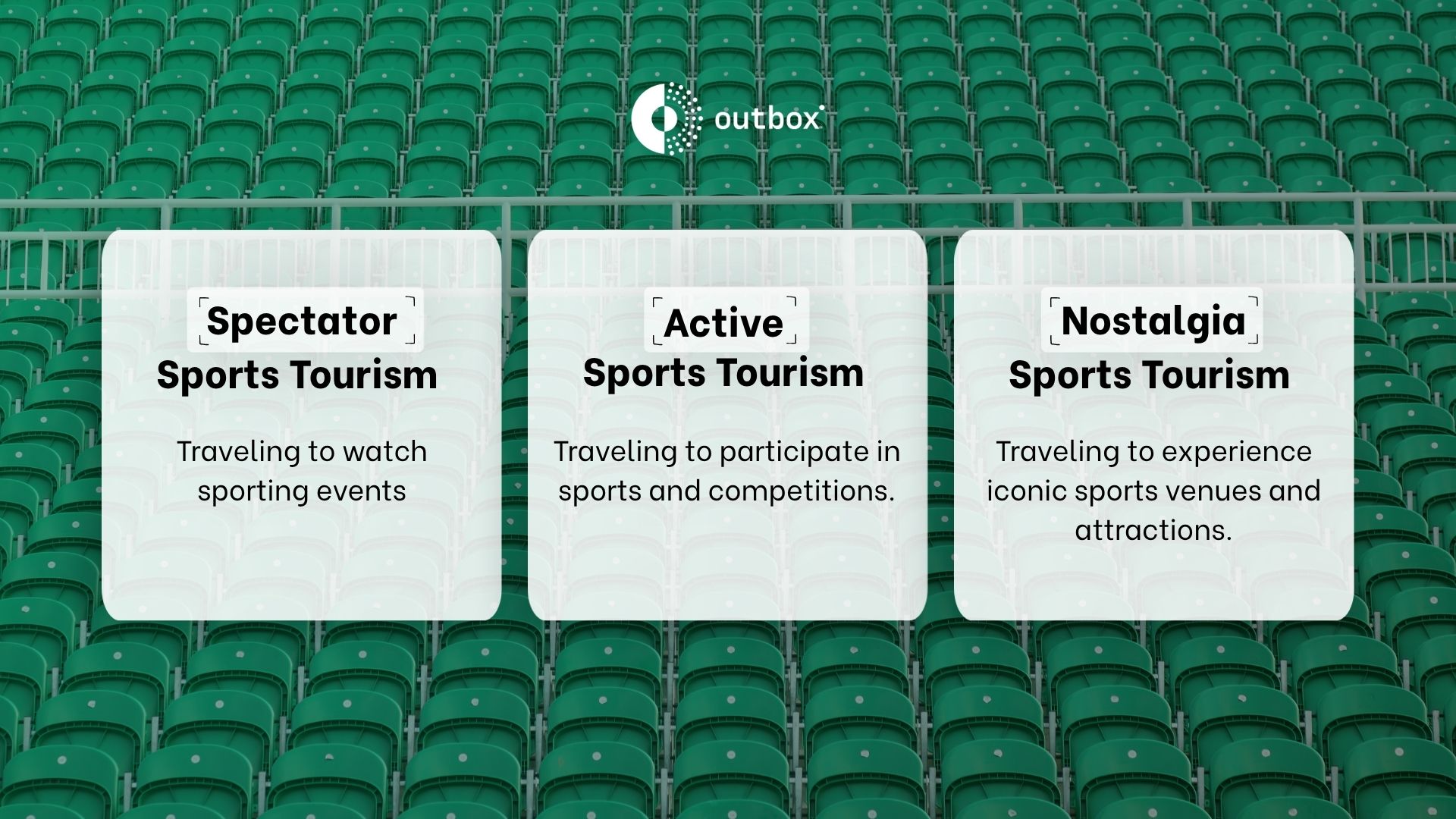
To capitalize on this sector, destination planners must first understand its multi-faceted nature. According to data compiled by UN Tourism, sports tourism represents roughly 10% of global tourism expenditure. The market is generally classified into three distinct categories, each attracting different visitor demographics and yielding unique economic footprints.
- Spectator Sports Tourism (Passive): Traveling to watch a sporting event. This includes mega-events like the FIFA World Cup or regional tournaments like the AFC Asian Cup, which draw massive, high-volume crowds over a concentrated period. Data from Coherent Market Insights indicates passive sports tourism remains the largest market segment, capturing 38.2% of the total share.
- Active Sports Tourism: Traveling to actively participate in a sporting event or activity. Examples include mass-participation marathons, amateur golf tournaments, and adventure races. These travelers often stay longer, travel with support networks like coaches or family, and possess high-spending profiles.
- Nostalgia Sports Tourism: Traveling to visit sports-related attractions outside of an active event window. This includes touring iconic venues like Tokyo’s Olympic Stadium, visiting sports halls of fame, or exploring sports museums. This segment helps maintain destination relevance and generates revenue during the traditional off-season.
The true power of sports tourism lies in its cross-sectoral integration. When an athlete or a fan travels to a destination, their footprint extends far beyond the stadium or racecourse. It triggers a complex economic chain reaction that intersects with hospitality, transportation, retail, entertainment, and digital media, effectively elevating the entire visitor economy.
The Tripartite Benefits of Sports Tourism
The returns on a well-executed sports tourism strategy span economic, reputational, and social dimensions.
- Economic Returns and Accelerated Spending
The most immediate justification for sports tourism investment is its direct economic injection. Unlike traditional leisure tourists who may concentrate spending within specific tourist enclaves, sports tourists diversify their spending across the local economy.
- Premium Accommodation and F&B: Inbound sports travel drives up hotel occupancy rates and Average Daily Rates, benefiting both luxury properties and mid-scale hospitality businesses.
- Micro-Economy Stimulation: Increased demand for local transportation, including ridesharing, train networks, and car rentals, along with retail spending on souvenirs and sports gear, channels capital directly into municipal ecosystems.
- Job Creation and Tax Revenue: Large-scale events demand a robust seasonal and permanent workforce, from event production and security to hospitality staff, while simultaneously bolstering local and national tax bases through visitor spending.
- Destination Development and Branding
Beyond immediate financial injections, sports tourism serves as a powerful catalyst for long-term destination transformation. Hosting prominent events provides unparalleled global media exposure, effectively acting as a multi-million-dollar marketing campaign that rebrands a city on the world stage.
Furthermore, major events accelerate public and private infrastructure improvements, such as upgraded transit systems, modernized airport terminals, and new recreational facilities. These assets enhance the destination’s competitiveness long after the event concludes, ensuring sustained leisure and business travel.
- Community and Social Legacy
The benefits of sports tourism extend inward to local residents. Successful events foster profound community pride and civic engagement through volunteer programs. Moreover, by bringing elite and mass-participation sports to a community’s doorstep, these initiatives promote local health, wellness, and grassroots sports participation, leaving a lasting social legacy that strengthens community cohesion.
Success Stories Across Asia
Asia’s diverse landscape provides an ideal canvas for sports tourism, with cities and regions leveraging unique strategies to drive economic growth.
| Destination / Event | Primary Strategy | Core Impacts & Outcomes |
| Singapore
Formula 1 Grand Prix | High-profile spectator night race integrated into the urban core. | Data published by the Singapore Tourism Board indicates that the Singapore Grand Prix records massive attendance numbers, averaging over 302,000 spectators. At least 40% of these attendees travel from overseas. The event generates approximately USD 130 million annually in incremental tourist spending and acts as a corporate catalyst, bringing in 90,000 business delegates for parallel conferences and exhibitions.
|
| Tokyo, Japan
Olympic Games Legacy | Mega-event infrastructure and urban transformation. | The legacy of the Tokyo Olympics stretches far beyond the games themselves. According to reports from the Tokyo Metropolitan Government, the event triggered massive urban development and long-term destination visibility for Japan’s capital. The infrastructure investments, ranging from state-of-the-art transit networks to robust accessibility upgrades across city transit lines, permanently boosted Tokyo’s competitiveness for future global events and leisure tourism.
|
| Hong Kong
Standard Chartered Marathon | Mass-participation active sports tourism. | As a premiere active sports tourism event, this marathon draws tens of thousands of international and regional runners. Hospitality performance audits indicate that because active sport participants travel with families and support staff, the event drives a massive spike in multi-day hotel occupancy and hospitality retail spend, strengthening Hong Kong’s positioning as an active, energetic lifestyle hub.
|
| Hokkaido (Japan) & Taiwan
Regional Cycling Tourism | Rural and regional decentralized tourism. | Sports tourism is also a highly effective tool for decentralized regional development. According to a specialized report by Grand View Research, the cycle tourism market in Japan is projected to reach USD 16.4 billion by 2033. Regional registries from the Hokkaido Prefectural Government show the island attracts over 8.9 million international visitors annually, yielding ¥1.59 trillion in tourist spending. In this ecosystem, cycle tourism plays a critical role in distributing capital away from major cities. By drawing cyclists to historic mountain passes and coastal trails, Hokkaido spreads tourism wealth directly to local guest houses, rural restaurants, and regional operators.
|
Why Measuring Impact Matters
As sports tourism grows more competitive, governments and treasury boards are demanding greater accountability. Securing public funding or private sponsorship for a sports initiative can no longer rely on reputation alone. Reporting total ticket sales or raw attendance figures is no longer sufficient.
To justify investments and plan effectively, destination stakeholders must answer precise, data-driven questions:
- What was the net new economic injection, excluding local resident spending?
- Which specific business sectors experienced the highest velocity of visitor spending?
- Did the event generate sustainable employment or merely temporary spikes?
- What was the tangible return on investment for public funds allocated?
Without robust, empirical measurement, DMOs and policymakers risk misallocating resources, overestimating economic windfalls, or neglecting negative displacement effects where regular tourists avoid a city due to event crowding. Evidence-based tourism planning has transitioned from a best practice to an absolute necessity.
Moving Beyond Attendance: The Outbox Framework
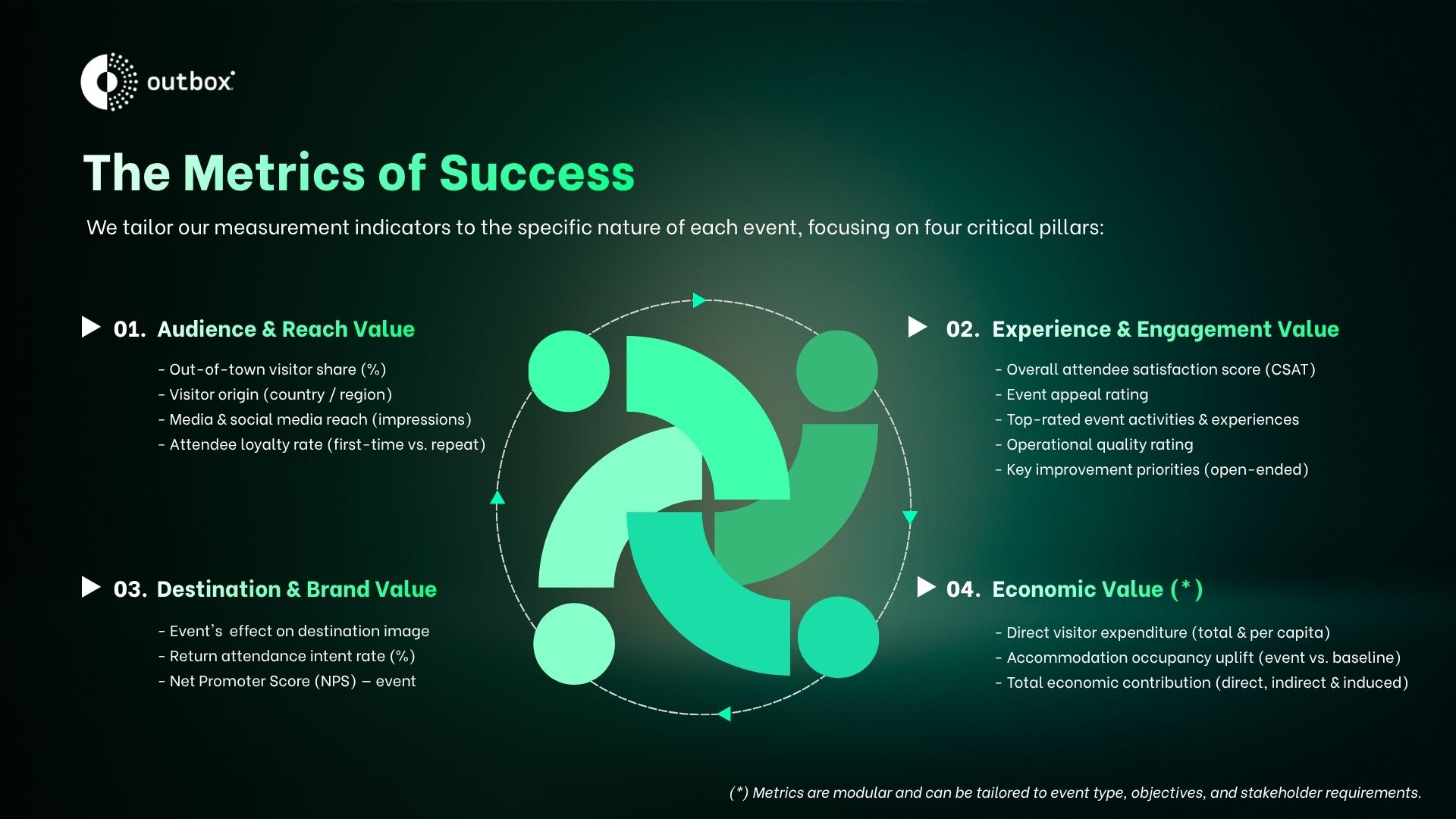
To help destinations move beyond attendance figures and visitor counts, Outbox’s Socio-Economic Impact Analysis framework utilizes a standardized model to evaluate event success. The framework measures performance across four critical pillars:
- 01. Audience & Reach Value: Measures who the event attracts and how far its message spreads. This includes auditing out-of-town visitor share percentages, visitor origin tracking across countries and regions, media and social reach impressions, and tracking long-term attendee loyalty rates comparing first-time versus repeat visitors.
- 02. Experience & Engagement Value: Evaluates how deeply attendees connect with the event itself. This covers overall attendee satisfaction scores (CSAT), event appeal ratings, pinpointing top-rated event activities or experiences, operational quality ratings, and analyzing key improvement priorities through open-ended attendee feedback.
- 03. Destination & Brand Value: Assesses the long-term legacy left on the host city. This tracks the event’s direct effect on the destination image, return attendance intent rates, and the event-specific Net Promoter Score (NPS) to evaluate future tourism pipelines.
- 04. Economic Value: Focuses on the precise financial injection into the community. This quantifies direct visitor expenditure both in total and per capita, tracks accommodation occupancy uplift compared to traditional seasonal baselines, and calculates the total economic contribution across direct, indirect, and induced levels.
By deploying this specific four-pillar framework, destination planners can move from defensive guesswork to precision, leveraging clear data to optimize event portfolios, justify regional investments, and confidently secure stakeholder buy-in.
Conclusion
Sports tourism is no longer simply about hosting events. It is a sophisticated engine of macroeconomic growth and urban evolution across Asia. The destinations that will dominate the next decade are not simply those with the largest stadiums or the biggest budgets, but those that approach sports tourism with strategic rigor.
The most successful destinations are those that understand, measure, and maximize the broader economic, social, and community value that sports tourism creates. By treating sports events as long-term investments in destination branding, infrastructure, and community welfare, Asia’s tourism leaders can build highly competitive, resilient, and vibrant visitor economies that deliver value long after the crowds have gone home.