Rethinking Growth in Vietnam’s Tourism Economy
Vietnam’s tourism sector has reached a clear milestone in 2025. International arrivals have surpassed pre-pandemic levels, and Vietnam total tourism revenue in 2025 has crossed the unprecedented threshold of 1 quadrillion VND (approximately USD 39 billion). By conventional measures, the recovery phase is complete.
Yet these headline figures obscure a more fundamental question: is growth in visitor numbers translating into proportional economic value?
Insights from Vietnam Travel Landscape Report 2026 suggest that while scale has returned, value creation has not advanced at the same pace. This divergence points to a structural issue within Vietnam’s tourism economy—one that is less about demand recovery and more about value efficiency.
A System Expanding in Volume, Not in Yield: A Comparison of 2023 and 2025
The contrast between 2023 and 2025 provides a useful lens to assess how Vietnam’s tourism growth has evolved.
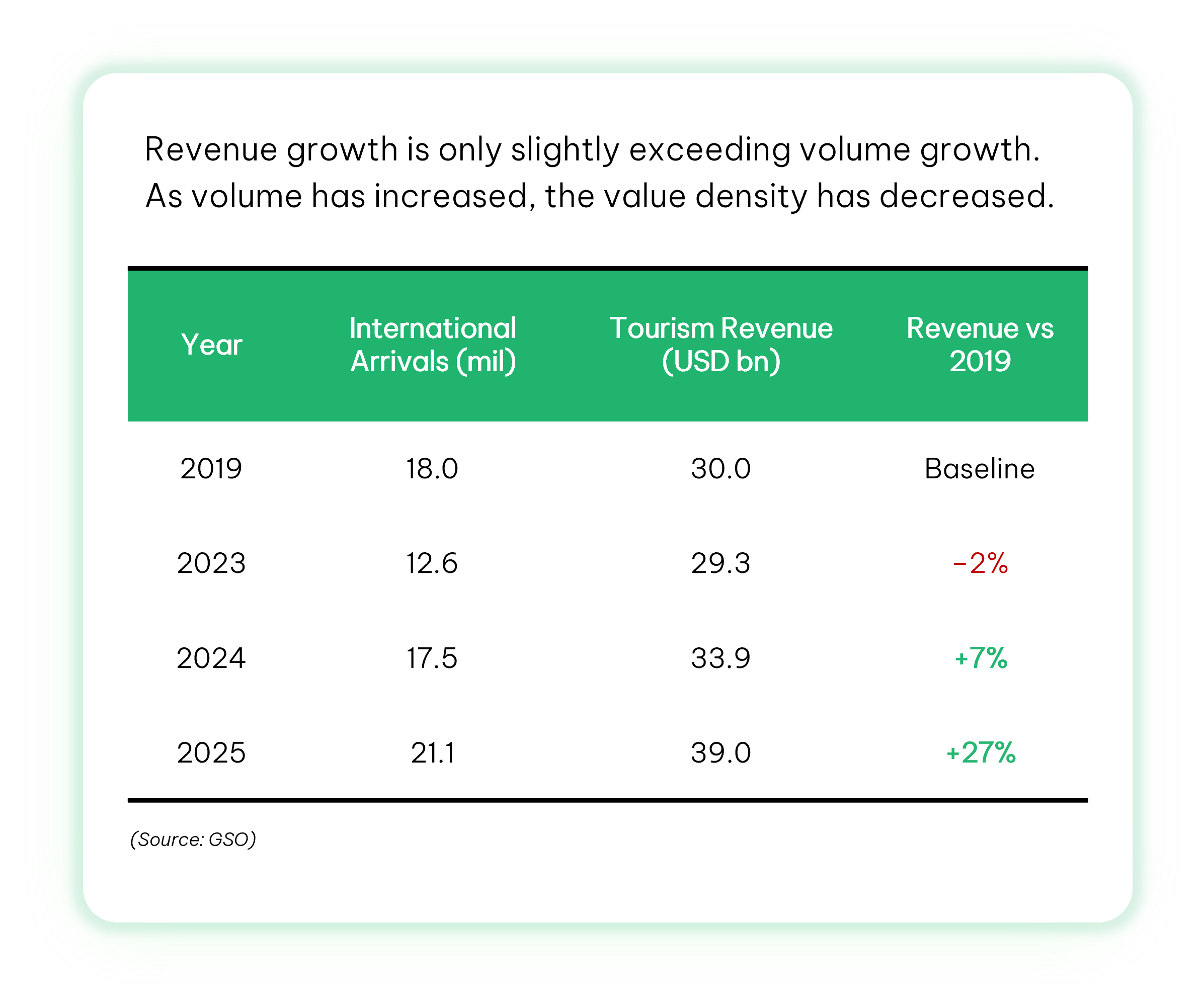
In 2023, Vietnam recorded 12.6 million international arrivals, yet tourism revenue reached USD 29.3 billion—only slightly below 2019 levels. This indicates relatively high spending intensity during the early recovery phase, when travel demand was still constrained but skewed toward higher-value segments.
By 2025, international arrivals increased significantly to 21.1 million, while total tourism revenue rose to around USD 39 billion. Although both indicators improved, revenue growth has largely moved in parallel with volume growth rather than exceeding it.
This suggests that the increase in visitor numbers has not been accompanied by a proportional increase in value per visitor. Instead, the system is expanding in scale without a corresponding improvement in spending efficiency.
Why Higher Value Has Been Difficult to Achieve
The persistence of this pattern is not incidental. It is shaped by how Vietnam’s tourism system is currently structured across demand, product, and positioning.
1 – Market Concentration in Short-Haul, Price-Sensitive Segments
Vietnam’s inbound tourism remains heavily concentrated in Northeast Asian markets. These markets are effective in driving large volumes, particularly during recovery phases, but they are typically associated with shorter stays and tighter travel budgets.
As a result, growth is supported by frequency rather than high per-trip spending.
2 – Brand Positioning Anchored in Affordability
Vietnam performs strongly on familiarity and appeal, particularly as an affordable destination with attractive natural landscapes. These attributes reduce barriers to entry and sustain demand, especially among regional travelers. However, they also anchor price expectations at a lower range, making it more difficult to justify premium pricing or to shift perception toward higher-value experiences.
3 – Limited Depth in Tourism Experiences
Although Vietnam offers diverse attractions, the ability to consistently deliver high-value, differentiated experiences remains uneven.
Gaps in service quality, experience design, and destination management reduce opportunities to extend length of stay or increase discretionary spending—both critical drivers of tourism yield.
4 – Domestic Tourism as a Volume Stabilizer, Not a Yield Driver
Domestic tourism plays a significant role, contributing nearly half of total tourism revenue. It provides stability, high frequency, and resilience.
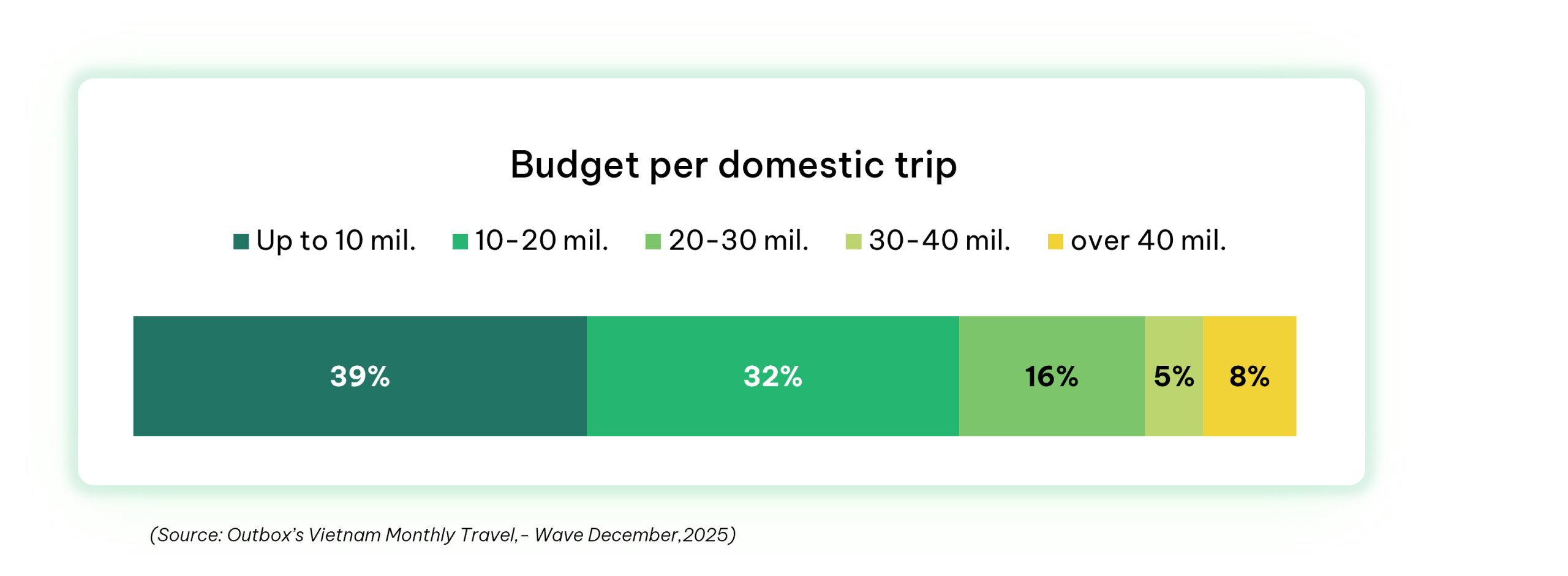
However, domestic travel in Vietnam is largely characterized by shorter trips and moderate budgets, with the majority of spending below VND 20 million per trip. This reinforces overall volume while placing a natural ceiling on value growth.
Breaking the Cycle: A Value-Led Growth Roadmap
To move beyond the high-volume, low-yield trap, Vietnam must shift toward value-led growth tourism, where the focus is not on maximizing arrivals, but on maximizing value per visitor.
This transition requires a coordinated, multi-layered approach:
1 – Redefining success metrics
Tourism performance should be evaluated through yield-based indicators—such as revenue per visitor, length of stay, and experience spend—rather than arrival numbers alone. This reframing is essential to align policy and investment priorities with value creation.
2 – Repositioning the destination brand
Vietnam must evolve from being perceived as “affordable and beautiful” to offering distinct, experience-driven value. This includes strengthening narratives around culture, gastronomy, wellness, and curated journeys that justify higher spending.
3 – Developing mid-premium and premium segments
Rather than targeting luxury at the top end alone, Vietnam has a significant opportunity in the mid-premium space—where experience quality, personalization, and service consistency can drive meaningful increases in tourism yield per visitor.
4 – Leveraging domestic tourism as a testing ground
Domestic travel, already a structural stabilizer, can play a strategic role in piloting pricing strategies, service improvements, and new experience formats before scaling them to international markets.
5 – Diversifying source markets for higher-value demand
Expanding beyond core Northeast Asian markets into long-haul and higher-spending segments will be critical to improving overall value density and reducing dependence on volume-driven growth.